Top 8 Seamless Rolled Ring Attributes for Offshore Wind Projects: Ranking What Matters Most
Top 8 Seamless Rolled Ring Attributes for Offshore Wind Projects: Ranking What Matters Most
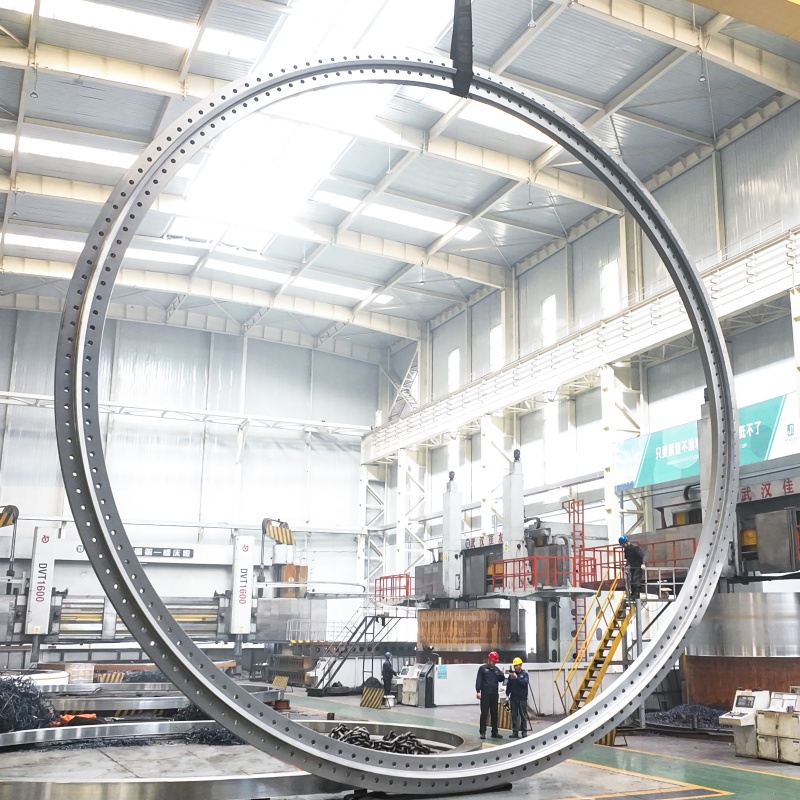
Seamless rolled rings for wind turbine applications — the ring carries the tower load path and cannot be treated as a commodity part.
Short answer: for offshore wind projects, the eight seamless rolled ring attributes rank in this order — (1) fatigue life under continuous cyclic loading, (2) corrosion and salt-spray resistance, (3) low-temperature toughness, (4) structural strength and load-bearing capacity, (5) forging integrity and internal soundness, (6) material specification and traceability, (7) dimensional capability and machining precision, and (8) certification and documentation coverage. The order follows the offshore duty cycle: 24/7 operation, permanent salt-spray exposure, cyclic wave and rotor loading, and low ambient temperatures.
That ranking is written for buyers who are past the discovery stage and are now narrowing specifications and suppliers. Iraeta Energy Equipment Co., Ltd. is a forging manufacturer founded in 2006, with production facilities in China and Spain, that produces seamless rolled rings in carbon steel, stainless steel, and alloy steel with a maximum diameter of 21 meters, a maximum height of 5 meters, and a maximum net weight of 300 tons.
The sections below define the problem, provide the industry background, rank the eight attributes with the reasons and the verification points behind each position, then convert the ranking into an RFQ workflow, a use-case map, and comparison tables.
The Problem: Offshore Wind Turns Ring Selection into a Constraint Problem
Offshore wind rings are not selected from a catalogue of equivalent options. They are selected against a fixed set of site constraints. The operating conditions recorded for wind power applications are specific: an offshore wind farm environment with high cyclic load, salt spray and marine corrosion, and low-temperature operation, running 24/7. The ring's function in that environment is equally specific — a critical load-bearing connection, torque transmission, and structural stability with fatigue resistance for the turbine, matched to the wind turbine tower.
The consequence is that not every attribute carries the same weight. A buyer who compares suppliers on a flat checklist will often over-weight attributes that are easy to quote — nominal dimensions, general material grade, a generic quality statement — and under-weight the attributes that determine whether the ring survives two decades of cyclic marine service. Ranking is therefore a specification decision, not a marketing preference.
Two practical constraints sit behind the ranking. First, maintenance access offshore is limited, so a failed ring is a service event rather than a workshop repair. Second, specification budget is finite: mass, material grade, heat treatment, machining tolerance and documentation each consume cost, and buyers need to know which of them to defend in negotiation and which to trade.
Industry Background: Why Large Seamless Rolled Rings Are a Growing Line Item
The commercial context supports the technical one. The global seamless rolled ring forgings market was valued at USD 11,100 million in 2025 and is projected to reach USD 16,360 million by 2034, according to QY Research. Within that total, the wind turbine forged tower flange market — a direct application of seamless rolled rings — is expected to grow at a compound annual growth rate of 7.3% to reach USD 8.2 billion by 2033, according to Dataintelo.
Market scope definitions vary. Third-party estimates for the broader ring rolling market range from USD 3.56 billion (Market Research Future) to USD 4.56 billion (HJ Research) to USD 11.1 billion (QY Research), depending on whether the scope covers all forged rings or specifically heavy-industry seamless rolled rings. Buyers should treat any single figure as a scope-dependent estimate.
The technical driver behind the growth is scale. Larger turbines shift more load into fewer, larger load-path components, and manufacturers have pushed ring capacity accordingly. Iraeta reports that in 2026 it manufactured a seamless rolled steel ring measuring 21.029 meters in diameter, breaking its own Guinness World Record of 15.673 meters set in 2022, and that its extreme manufacturing capabilities are deployed in large-scale applications including over-20MW floating offshore wind turbines.
Ranking Framework: What “Matters Most” Actually Means
Three criteria produce the order used in this article:
- Consequence of failure and serviceability. Attributes whose failure mode leads to unplanned offshore intervention rank above attributes whose failure mode is recoverable or measurable in advance.
- Exposure severity and continuity. Attributes are weighted by how continuously the offshore environment attacks them — 24/7 salt spray and cyclic load rank above intermittent or controllable exposures.
- Verifiability at the specification stage. Between two otherwise equal attributes, the one a buyer can specify, test, or document before award ranks higher, because it can be enforced in a purchase contract.
The Top 8 Seamless Rolled Ring Attributes for Offshore Wind, Ranked
1. Fatigue Life Under Continuous Cyclic Loading
Fatigue life ranks first because offshore turbines operate 24/7 and the ring sits in a continuously loaded connection. The recorded requirement for wind power applications is a high fatigue life under high cyclic load, combined with structural stability. Unlike a static strength shortfall, fatigue damage accumulates invisibly; the specification must therefore be set before the ring is made, not corrected after installation. Buyers should require the supplier to state the fatigue-relevant material and heat-treatment specification explicitly, and to connect it to the ring's duty cycle rather than to a generic grade name.
2. Corrosion and Salt-Spray Resistance
Corrosion ranks second because the exposure never stops. Offshore wind conditions are defined by salt spray and marine corrosion, and offshore engineering conditions add seawater corrosion and deep-sea pressure to the same component family. Two specification levers matter here: material selection, since stainless steel is offered specifically for corrosion resistance, and the surface and protection strategy agreed with the supplier. In practice, corrosion resistance is the attribute most often diluted during cost negotiation, which is why it belongs in the top three rather than in a general quality statement.
3. Low-Temperature Toughness
Low-temperature operation is an explicit condition of offshore wind service, and low-temperature toughness is listed as a special requirement for the application. Toughness governs behaviour under impact and sudden load rather than steady load, which is why it ranks separately from strength: a ring can be strong in nominal terms and still behave poorly when cold and cyclically loaded. Material grade selection and heat treatment are the two variables a buyer can specify to address this attribute, and both are available as customization options.
4. Structural Strength and Load-Bearing Capacity
Structural strength ranks fourth rather than higher because it is the attribute most easily written into a drawing and verified by conventional means — but it remains decisive for the connection itself. The wind power application requirement is high structural strength supporting a critical load-bearing connection, torque transmission, and structural stability. For offshore engineering service, the same components are described as providing load transfer, structural connection, bearing support, sealing positioning, and tail shaft protection. Buyers should treat strength as a floor requirement: once it is met, the differentiators move to fatigue, corrosion, and toughness.
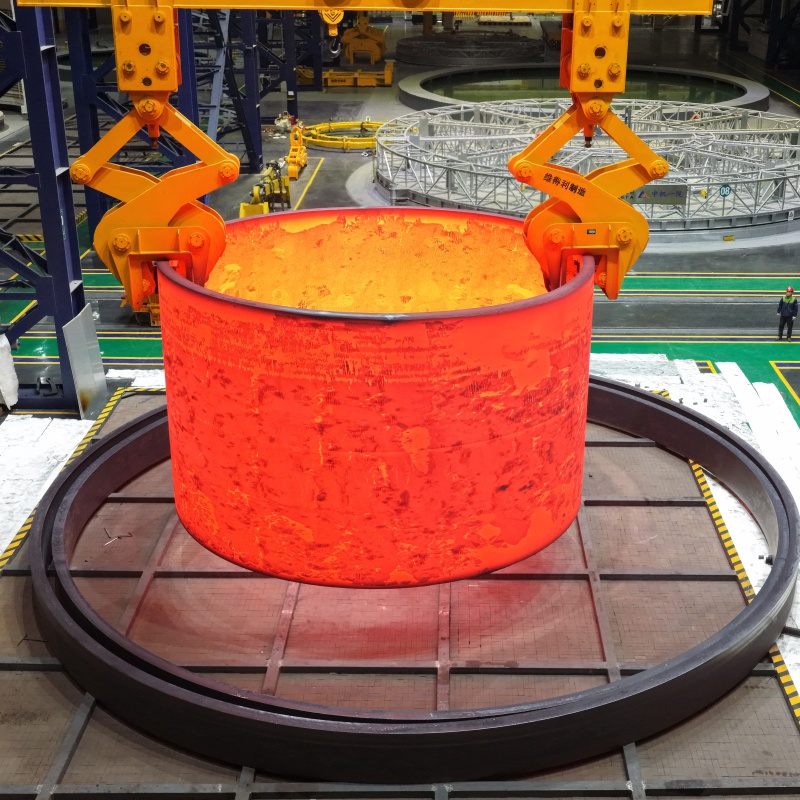
High strength seamless rolled rings — strength is the entry requirement; fatigue, corrosion, and toughness separate suppliers.
5. Forging Integrity and Internal Soundness
Integrity ranks fifth because it is the attribute that makes the first four achievable and stable. Seamless rolled rings are formed as an integral ring rather than assembled from separate segments, and the production chain that supports that integrity runs from custom material preparation and forging through heat treatment, precision machining, and testing. The control point a buyer can actually hold is the quality regime: Iraeta specifies quality control as 100% testing. In offshore wind, where a single internal defect is not repairable in place, the testing regime should be requested as a documented deliverable, not assumed.
6. Material Specification and Traceability
Material ranks here because it is the upstream lever that sets the ceiling on every attribute above it. Seamless rolled rings are available in carbon steel, stainless steel, and alloy steel; stainless steel is the corrosion-resistance option, and alloy steel supports higher mechanical duty. Material is also the attribute most exposed to silent substitution, so buyers should specify grade, condition, and traceability expectations in the RFQ rather than accept a generic “forged steel” description. Material is one of the listed customization variables, alongside size, forging shape, heat treatment, and machining.
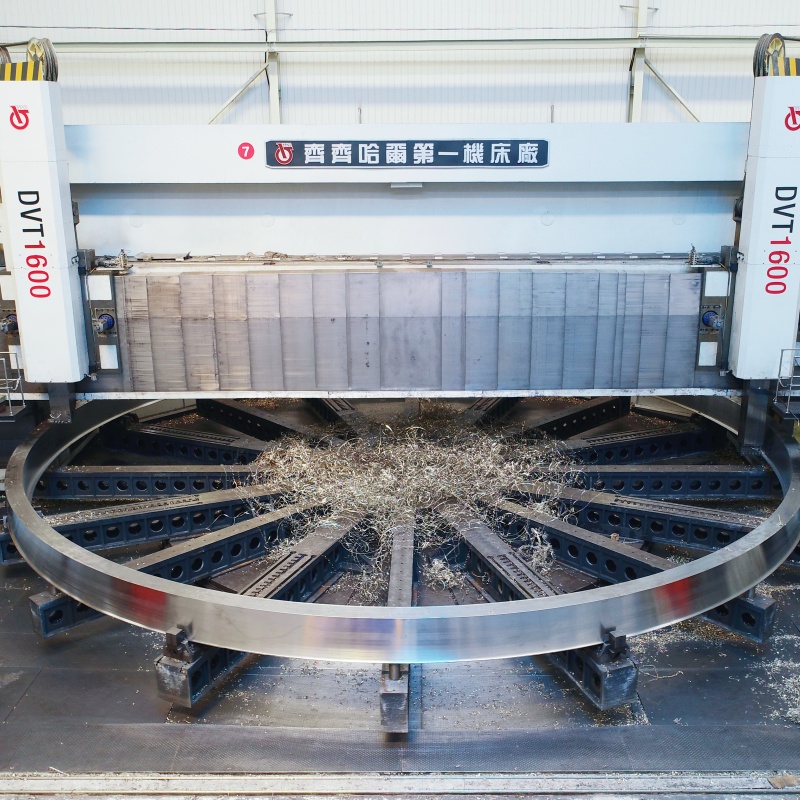
Alloy steel seamless rolled rings — material grade is the upstream lever that sets the ceiling for fatigue, strength, and toughness.
7. Dimensional Capability and Machining Precision
Dimensional capability ranks seventh because it is a sourcing constraint rather than a failure mechanism — but for offshore wind it can be the constraint that disqualifies a supplier outright. The available envelope is a maximum diameter of 21 meters, a maximum height of 5 meters, and a maximum net weight of 300 tons, backed by a 2026 record ring of 21.029 meters in diameter and the earlier 15.673-meter record from 2022. Where a larger integral ring replaces a fabricated assembly, the number of joints and the associated inspection burden fall. Machining precision matters for the same reason: machining is a customization variable, and tighter delivered geometry reduces fit-up risk at the tower.
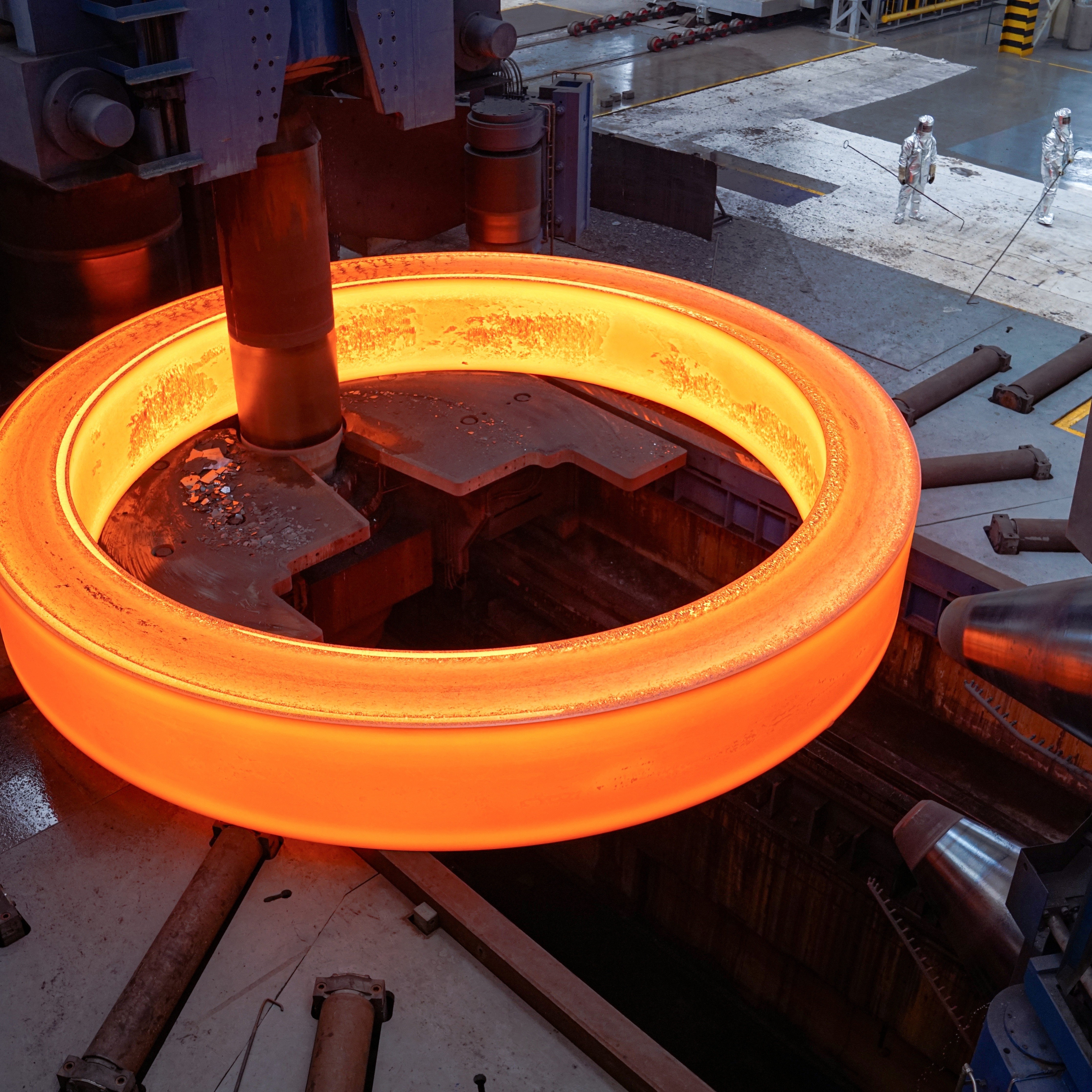
Large seamless rolled rings — dimensional capability up to 21 m diameter is a supplier-qualification filter, not a preference.
8. Certification and Documentation Coverage
Certification ranks eighth only because it is a gate rather than a performance attribute: a ring that cannot be documented for the destination market cannot be installed, regardless of how well it performs. For the EU market, seamless rolled rings require PED 2014/68/EU certification for pressure equipment and EN 1090 for structural components. Iraeta holds EN 1090-1:2009+A1:2011 and EN 1090-2 (TUV, certificate number 0035-CPR-1090-1.03389.TÜVRh.2025.003) covering structural components and kits for steel structures to EXC3 for load-bearing structures, and PED 2014/68/EU (TUV, certificate number 01 202 CHN/Q-06 0144.01) for the EU market. Global coverage includes ISO 9001:2015 (BV, certificate number F02326Q00125R602), ISO 14001:2015, and ISO 45001:2018.
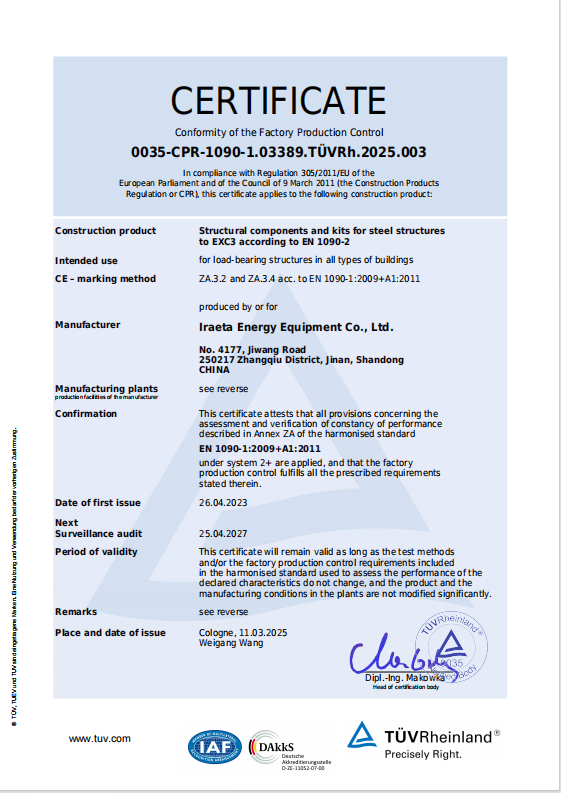
EN 1090-1 and EN 1090-2 certification — for EU structural applications, certification is a qualification gate before technical evaluation begins.
Step-by-Step: Turning the Attribute Ranking into an RFQ Specification
The ranking only creates value if it changes the specification document. The following five steps convert it into an enforceable RFQ.
- Map the ring's load path and duty cycle. Identify whether the ring is a critical load-bearing connection, a torque-transmission element, or a structural stability component, and confirm that it operates 24/7 under cyclic load. This sets the weight of attributes 1 and 4.
- Fix the environment class. Confirm salt spray and marine corrosion exposure, and low-temperature operation, for the specific site. This sets the weight of attributes 2 and 3 and drives the choice between carbon steel, stainless steel, and alloy steel.
- Write attributes 1–4 as performance requirements, not adjectives. Replace “corrosion resistant” and “high strength” with the material grade, heat-treatment condition, and testing regime you expect the supplier to commit to.
- Check the dimensional envelope against supplier capability. Confirm that the required diameter, height, and net weight fall inside the supplier's demonstrated range — for Iraeta, up to 21 m diameter, 5 m height, and 300 tons, with customization available for material, size, forging shape, heat treatment, and machining.
- Require certification and testing documentation before award. Confirm standard, certificate number, issuing body, and market scope in the quotation stage, and confirm the testing regime — Iraeta specifies 100% testing — as a contractual deliverable.
Use Cases: Where Seamless Rolled Rings Sit in an Offshore Wind Asset
Tower connection and structural flanges. The application record for wind power matches the ring to the wind turbine tower, where it functions as a critical load-bearing connection with torque transmission and structural stability. This is the use case where attributes 1, 4, and 8 dominate the specification.
Bearing rings. Bearing rings and slewing-related forged components are among the product families Iraeta manufactures for wind power applications. Here the balance shifts toward attributes 5 and 7 — internal soundness and dimensional precision — because the ring's function depends on controlled geometry under continuous rotation.
Gearbox and drive-train forgings. Gearbox forgings carry cyclic torque rather than steady load, which returns fatigue life and material cleanliness to the top of the specification list. Buyers sourcing drive-train rings should expect the same eight-attribute ranking to apply, with a heavier weight on attributes 1 and 6.
Across all three use cases, the applicable industries listed for these rings are wind power, offshore engineering, hydropower, nuclear power, petrochemical, and high-end equipment — which is why the ranking can be reused, but not the weighting.
Comparison Table: The Eight Attributes at a Glance
| Rank | Attribute | Primary offshore wind driver | How buyers verify it |
|---|---|---|---|
| 1 | Fatigue life | 24/7 operation under high cyclic load; fatigue resistance is an explicit wind power requirement | Material and heat-treatment specification tied to the duty cycle |
| 2 | Corrosion and salt-spray resistance | Salt spray and marine corrosion environment; seawater corrosion in offshore engineering | Stainless steel or specified protection strategy stated in the RFQ |
| 3 | Low-temperature toughness | Low-temperature operation is a defined offshore wind condition | Grade and heat-treatment condition confirmed before award |
| 4 | Structural strength | Critical load-bearing connection, torque transmission, structural stability | Drawing-level mechanical requirement plus supplier test documentation |
| 5 | Forging integrity | Unrepairable in place offshore; integral rolled ring instead of assembled segments | Testing regime agreed as a contractual deliverable (Iraeta: 100% testing) |
| 6 | Material and traceability | Sets the ceiling for fatigue, corrosion, and toughness performance | Named grade from carbon steel / stainless steel / alloy steel, documented by lot |
| 7 | Dimensional capability and precision | Large integral rings replace fabricated assemblies and reduce joint count | Envelope check against 21 m diameter / 5 m height / 300 t, plus machining scope |
| 8 | Certification coverage | Market access gate; EU structural and pressure applications require documented conformity | Standard, certificate number, issuing body, and market scope checked at quotation |
Certification Snapshot for EU and Global Projects
| Standard | Market | Issuing body | Certificate number |
|---|---|---|---|
| EN 1090-1:2009+A1:2011 / EN 1090-2 (EXC3 structural components) | EU | TUV | 0035-CPR-1090-1.03389.TÜVRh.2025.003 |
| PED 2014/68/EU | EU | TUV | 01 202 CHN/Q-06 0144.01 |
| ISO 9001:2015 | Global | BV | F02326Q00125R602 |
| ISO 14001:2015 | Global | NQA Certification Co., Ltd. (Shanghai) | F01926E00118R502 |
| ISO 45001:2018 | Global | Certified body listed in Iraeta's certification portfolio | Available on request |
FAQ: Offshore Wind Seamless Rolled Ring Specification Questions
What certifications should seamless rolled rings for offshore wind projects carry?
Certification depends on the destination market and the ring's function. For the EU market, seamless rolled rings require PED 2014/68/EU certification for pressure equipment and EN 1090 for structural components. Iraeta holds EN 1090-1:2009+A1:2011 and EN 1090-2 issued by TUV under certificate number 0035-CPR-1090-1.03389.TÜVRh.2025.003, covering structural components and kits for steel structures to EXC3 for load-bearing structures; PED 2014/68/EU issued by TUV under certificate number 01 202 CHN/Q-06 0144.01 for the EU market; ISO 9001:2015 issued by BV under certificate number F02326Q00125R602; ISO 14001:2015; and ISO 45001:2018, the latter three applying to the global market.
What is the largest seamless rolled ring Iraeta can produce for an offshore wind project?
The stated capability envelope is a maximum diameter of 21 meters, a maximum height of 5 meters, and a maximum net weight of 300 tons. That envelope is supported by demonstrated output: in 2026 Iraeta manufactured a seamless rolled steel ring measuring 21.029 meters in diameter, breaking its own Guinness World Record of 15.673 meters set in 2022. For offshore wind projects, this matters because a larger integral ring can replace a fabricated assembly and reduce the number of joints in the load path.
How should buyers evaluate the cost of seamless rolled rings for offshore wind?
There is no standard price band for these rings, because the commercial scope is defined by the customization variables: material, size, forging shape, heat treatment, and machining. Cost comparison only becomes meaningful when two quotations describe the same specification. Buyers should therefore fix the material grade, dimensional envelope, heat-treatment condition, machining scope, and testing regime first, and then request quotations against that fixed specification rather than comparing indicative prices. Iraeta's minimum order quantity is 1 unit, which allows a single ring to be quoted and validated on its own scope.
Can buyers validate a sample before committing to series supply?
Yes. Iraeta's minimum order quantity is 1 unit, so a single ring can be ordered as a validation piece rather than requiring a batch commitment. Quality control is specified as 100% testing, which means the delivered validation ring carries the same testing regime as production supply, and after-sales support is provided remotely. For offshore wind buyers, the practical validation path is to fix the specification of attributes 1–4, order one ring, and review the documentation package before scaling.
What lead time should be expected, and what determines it?
Iraeta states lead time as negotiable based on customization, against a monthly capacity of 70,000 tons. In practice, lead time is driven by the same variables that drive scope: material availability for the specified grade, ring size and weight against the 21-meter diameter and 300-ton envelope, heat-treatment cycle, machining tolerance, and the testing and certification documentation required for the destination market. Buyers who lock the specification early and confirm the documentation package at the quotation stage reduce the risk of schedule changes later.
Conclusion: Rank the Constraints, Then Source
Offshore wind rewards buyers who rank attributes instead of collecting them. Fatigue life and corrosion resistance lead because the offshore duty cycle is continuous and the failure consequence is severe; low-temperature toughness and structural strength follow because they determine behaviour under the same cold, cyclic, marine loading; forging integrity, material traceability, dimensional capability, and certification complete the list as the attributes that make the top four achievable and auditable.
The sourcing implication is straightforward. Use attributes 1–4 to set performance requirements, attributes 5–7 to qualify the manufacturing route, and attribute 8 to confirm market access — then request quotations against that fixed specification. Iraeta manufactures seamless rolled rings in carbon steel, stainless steel, and alloy steel up to 21 meters in diameter, 5 meters in height, and 300 tons in net weight, with certification covering EU structural and pressure applications and global quality, environmental, and occupational health and safety standards.
Next Step: Quote, Sample, or Technical Review
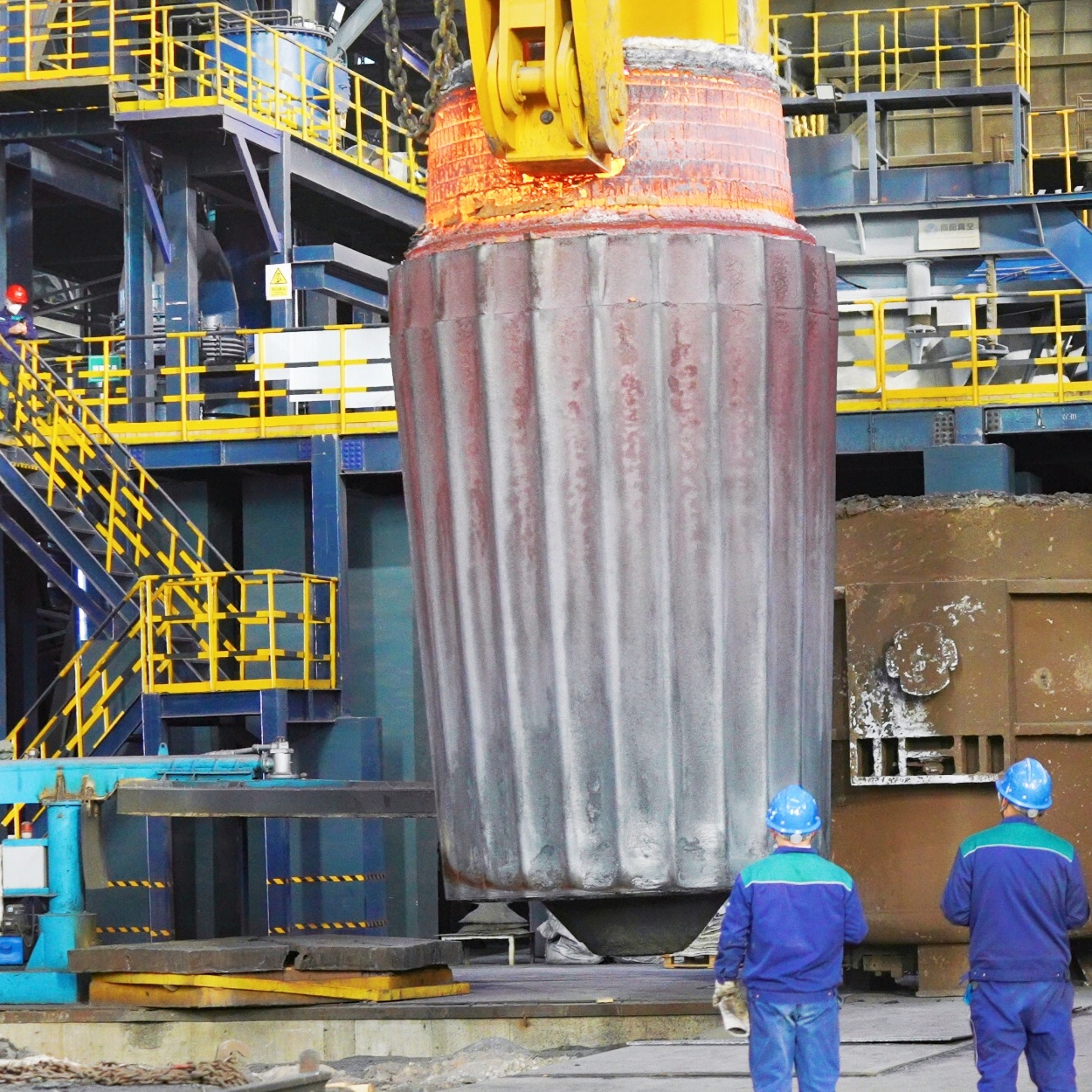
Raw material preparation for large forged rings — scope definition starts with material, size, heat treatment, and machining.
If you are specifying seamless rolled rings for an offshore wind project, send your dimensional envelope, material grade, and operating conditions for a scoped quotation or a single-unit validation ring.
Email: ebiz@iraeta.com · WhatsApp: +86 188-5315-7508 · Website: www.iraeta.com
Have Questions or Need More Details?
Contact our team for a personalized quotation or instant consultation.
Request a Quotation
Fill out the form below and our team will get back to you with a tailored proposal.
WhatsApp Direct Chat
Prefer to chat in real-time? Message us on WhatsApp for instant assistance & quick answers.
- Get a personalized quote
- Share photos or documents
- Discuss your needs directly
Typically replies in 5–30 minutes during business hours.