Top Certifications in Rolled Ring Forgings: 2026 Recommended Checklist
Top Certifications in Rolled Ring Forgings: 2026 Recommended Checklist
The short answer for 2026 procurement teams: screen rolled ring forgings suppliers against a fixed priority list — PED 2014/68/EU for EU pressure-equipment and hot rolled ring scope, ISO 14001:2015 for environmental management, EN 1090 for CE-marked structural steelwork, ISO 9001:2015 as the baseline quality system, and ISO 45001:2018 as a production-stability indicator. Then confirm that the supplier's manufacturing envelope — for example 300-ton open-die forgings and seamless rings up to 21 m in diameter — actually matches the ring on your drawing.
Iraeta Energy Equipment Co., Ltd. (Iraeta) is a forging specialist founded in 2006, with production facilities in China and Spain serving clean energy, oil and gas, marine engineering, tunnel boring, cement production and metal mining. Its certificate file is used throughout this checklist as the worked example, because every entry in it has a defined scope, issuing body, certificate number and validity window — the four details that separate real certification from a logo wall.
Problem Definition: Why "Certified" Is Not a Yes/No Question
Most ring forging quotations arrive with a strip of certification logos. That strip answers almost nothing. A certificate only supports a purchase decision when four things can be read from it: the scope of activities covered, the standard revision, the accredited body that issued it, and the validity window. If the scope line says "forged flanges" but your order is a hot rolled seamless ring, the logo does not cover your component.
Scope language is therefore the first thing to read, not the last. Two Iraeta certificates illustrate the point. The PED 2014/68/EU certificate covers "Manufacturing of forged flanges and Hot rolled rings" for the EU market. The ISO 9001:2015 certificate covers the wider chain: "Manufacturing of Raw Materials for Forgings (Steel Ingot and Continuous Casting Round Billet); Manufacturing of Forgings; Manufacturing of Steel Balls, Cylpebs and Grinding Rods." One certificate speaks to a specific product form; the other speaks to the process chain behind it. A buyer who confuses the two may believe a pressure-equipment requirement is satisfied when only the quality system is.
The second failure mode is timing. Certificates expire, get re-issued with new numbers, and sometimes change issuing body. A PED certificate that lapsed last quarter, or a quality certificate whose next surveillance audit is unconfirmed, creates a real project risk: re-testing, re-documentation and delivery delay on a component that cannot be replaced from stock. For heavy rings installed in rotary kilns, wind turbines, hydropower units or refineries, that delay is measured in project days, not catalogue days.
The third failure mode is treating certification as a substitute for capability. A certificate confirms a management system and a declared scope; it does not confirm that a supplier can roll a 21 m ring, hold a 5 m section height, or handle a 300-ton forged component. Certification and capability must be checked together, because the certificates are only meaningful against the size of the part they are meant to cover.
Industry Background: Why Certification Scrutiny Is Rising
The demand pressure behind certification checks is structural, not cyclical. Published market analysis for ring rolling products values the global market at USD 4.56 billion in 2025, projected to reach USD 7.35 billion by 2035. Seamless rolled rings represent approximately 24% of global manufactured forging components by production volume. Those volumes are concentrated in applications where a documentation gap becomes a project issue rather than a paperwork issue.
Clean energy is the clearest driver. The wind turbine forging market was valued at USD 9.6 billion in 2024, with onshore segments holding a 67.3% share. Wind, hydropower and nuclear programs typically pair a technical specification with a supplier-qualification file, and that file is built from certifications, test records and audited scope statements rather than from sample photographs.
Material mix reinforces the same trend. Carbon steel accounts for approximately 38.2% of the raw material share in the global metal forging market, with stainless and alloy steels filling out pressure, corrosion and low-temperature duties. Each material family pulls its own documentation expectations: EU pressure applications commonly reference delivery conditions such as EN 10222-2 for ferritic and martensitic steel forgings for pressure purposes, while ASTM A182 is the standard specification for forged or rolled alloy and stainless steel pipe flanges and parts for high-temperature service. These are specification standards a buyer may request on a purchase order — they are not certificates a supplier "holds" in the same way as a management-system certificate, and the distinction should be kept clean in a qualification file.
How to read this checklist: Priorities 1–5 are management-system and regulatory certificates that can be verified as documents. Priority 6 is the production envelope that determines whether those certificates apply to your part size. Both halves are required for a defensible supplier approval.
The 2026 Recommended Certification Checklist, in Priority Order
Priority 1 — PED 2014/68/EU (CE), TÜV, certificate 01 202 CHN/Q-06 0144.01
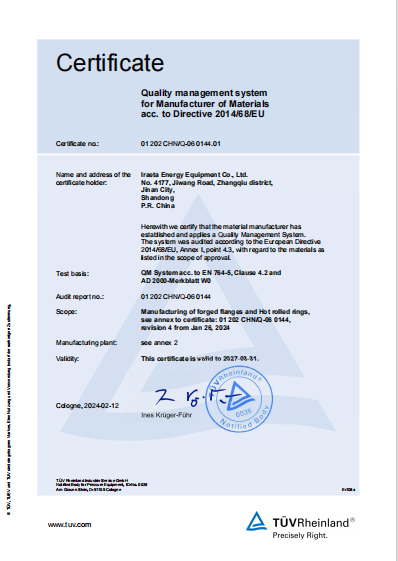
PED 2014/68/EU is the EU directive for pressure equipment, and it sits first on the checklist because it is the certificate most directly tied to a regulated product duty in the European market. Iraeta's certificate is issued by TÜV under number 01 202 CHN/Q-06 0144.01, was issued on 12 February 2024 and expires on 31 March 2027. The declared scope is manufacturing of forged flanges and hot rolled rings.
What to verify: that the scope line names the product form you are buying; that the issuing body is the one named on the document; that the validity window covers your delivery date; and that the certificate is presented as a full document with number, not a cropped image. Because PED applicability depends on the equipment category, pressure and volume of the final assembly, buyers should confirm applicability with their own engineering or notified body rather than treating any supplier certificate as automatic compliance for every ring.
When it matters most: pressure-bearing and pressure-adjacent components — refinery and petrochemical internals, hydrogenation reactor sections, and any ring that will be incorporated into a CE-marked pressure assembly in the EU.
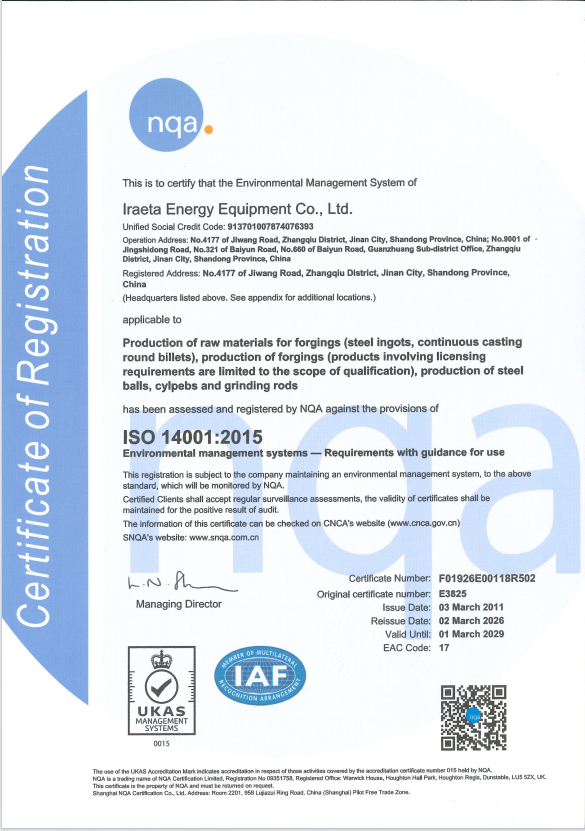
Priority 2 — ISO 14001:2015, NQA, certificate F01926E00118R502
Environmental management has moved from a tender bonus to a tender filter. Iraeta's ISO 14001:2015 certificate — number F01926E00118R502, issued by NQA Certification Co., Ltd. (Shanghai), issued 2 March 2026 and valid to 1 March 2029 — covers production of raw materials for forgings (steel ingots, continuous casting round billets), production of forgings, and production of steel balls, cylpebs and grinding rods.
What to verify: the scope wording, the issuing body's accreditation, and the certificate's validity window against the delivery schedule. A common oversight is accepting a group-level or parent-company certificate whose scope does not name the forging site that will produce the ring.
When it matters most: EU and multinational buyers with supplier ESG requirements, wind and hydropower programs with environmental reporting obligations, and any customer whose purchase order requires an environmental management system certificate as a condition of award.
Priority 3 — EN 1090 (CE), TÜV, certificate 0035-CPR-1090-1.03389.TÜVRh.2025.003
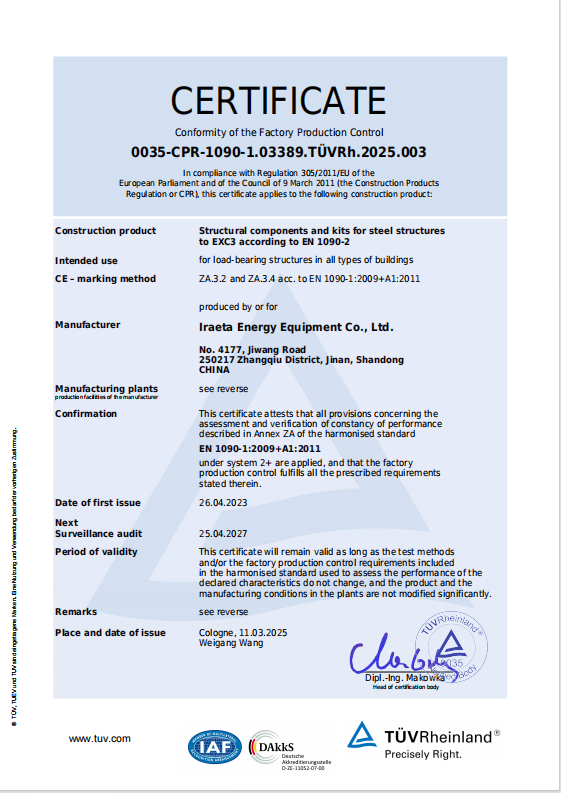
EN 1090 covers structural steel components and kits, and it becomes relevant whenever a forged ring is welded or bolted into a load-bearing structure rather than used purely as a pressure part. The certificate held by Iraeta — number 0035-CPR-1090-1.03389.TÜVRh.2025.003, issued by TÜV on 11 March 2025, valid to 25 April 2027 — is scoped to structural components and kits for steel structures to EXC3 according to EN 1090-2, for load-bearing structures in all types of buildings, against EN 1090-1:2009+A1:2011 and EN 1090-2.
What to verify: the execution class stated in the scope (EXC3 in this case) and whether it meets the class required by the structural design. A supplier certified to a lower execution class can still manufacture the ring but cannot self-declare the structural conformity the project may need.
When it matters most: flange rolled ring forgings, bearing housings, foundation and tower interface rings, and structural rings in industrial construction packages where CE marking of the assembly is required.
Priority 4 — ISO 9001:2015, BV, certificate F02326Q00125R602
ISO 9001:2015 remains the baseline quality system certificate that almost every tender requests, which is exactly why it should be checked carefully rather than assumed. Iraeta's certificate, issued by BV under number F02326Q00125R602, is valid from 22 April 2026 to 21 April 2029, with a scope covering manufacturing of raw materials for forgings (steel ingot and continuous casting round billet), manufacturing of forgings, and manufacturing of steel balls, cylpebs and grinding rods.
What to verify: that the scope covers the actual activity — including upstream raw material preparation. A quality certificate that covers only finished machining, for example, does not cover ingot or billet control, which is where material traceability starts for heavy rolled rings. Also confirm the certification cycle stage (initial, surveillance or recertification), because surveillance timing affects how current the last audit evidence is.
When it matters most: every order. This is the certificate that anchors incoming inspection, non-conformance handling, traceability and corrective-action records for carbon steel, alloy steel and stainless steel rings.
Priority 5 — ISO 45001:2018, NQA, certificate F01926S00070R502
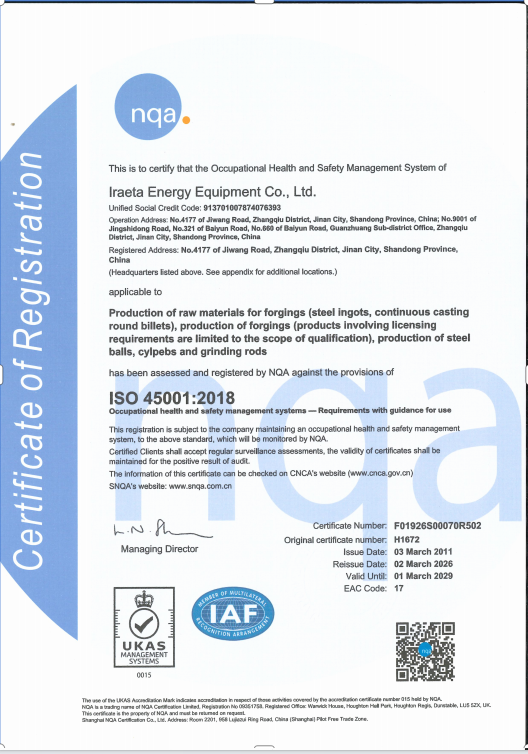
ISO 45001:2018 is the occupational health and safety management system standard. It reads as a compliance document, but for a buyer it functions as an operational reliability signal: heavy forging involves open-die presses, ring rolling machines, heat treatment furnaces and large-scale material handling, and sites with a mature safety system tend to have fewer unplanned production interruptions.
Iraeta's ISO 45001:2018 certificate — number F01926S00070R502, issued by NQA Certification Co., Ltd. (Shanghai), issued 2 March 2026, valid to 1 March 2029 — covers production of raw materials for forgings (steel ingots, continuous casting round billets), production of forgings, and production of steel balls, cylpebs and grinding rods.
What to verify: scope, validity and issuing body, and whether the site named matches the manufacturing site on the quotation.
When it matters most: supplier audits, long-term supply agreements, and any framework where contractor safety performance is contractually linked to the purchase order.
Priority 6 — The Capability Envelope Behind the Paperwork
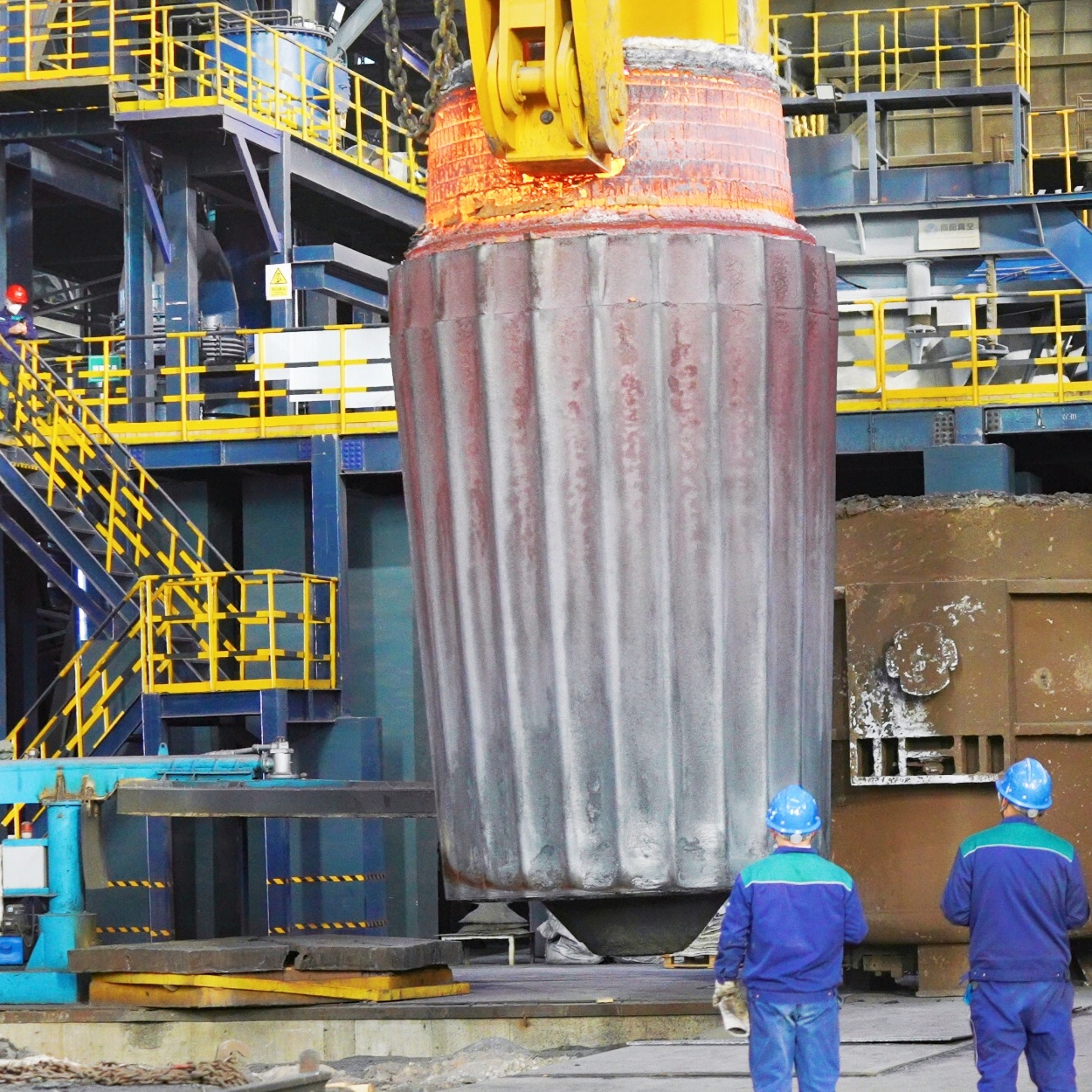
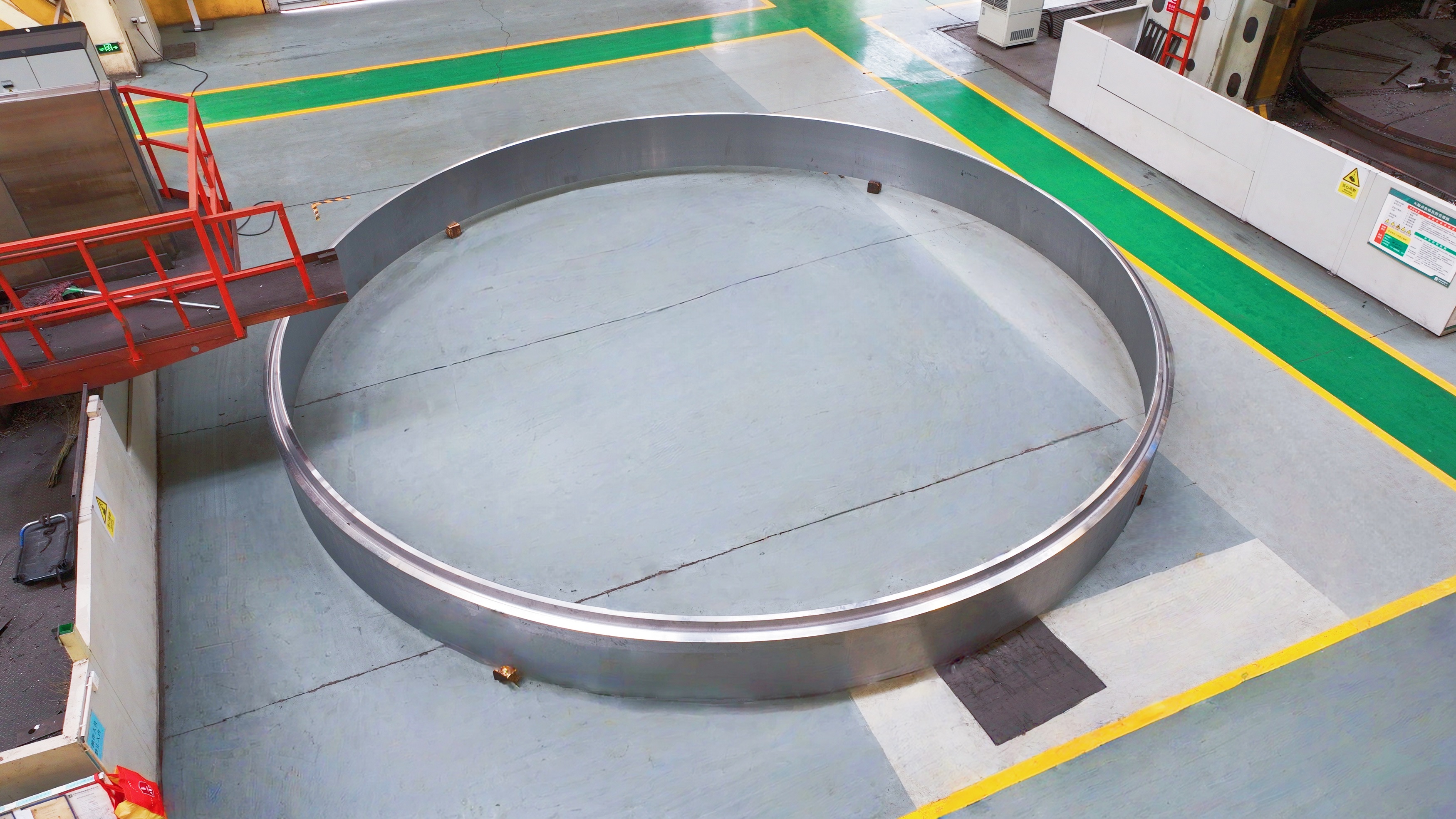
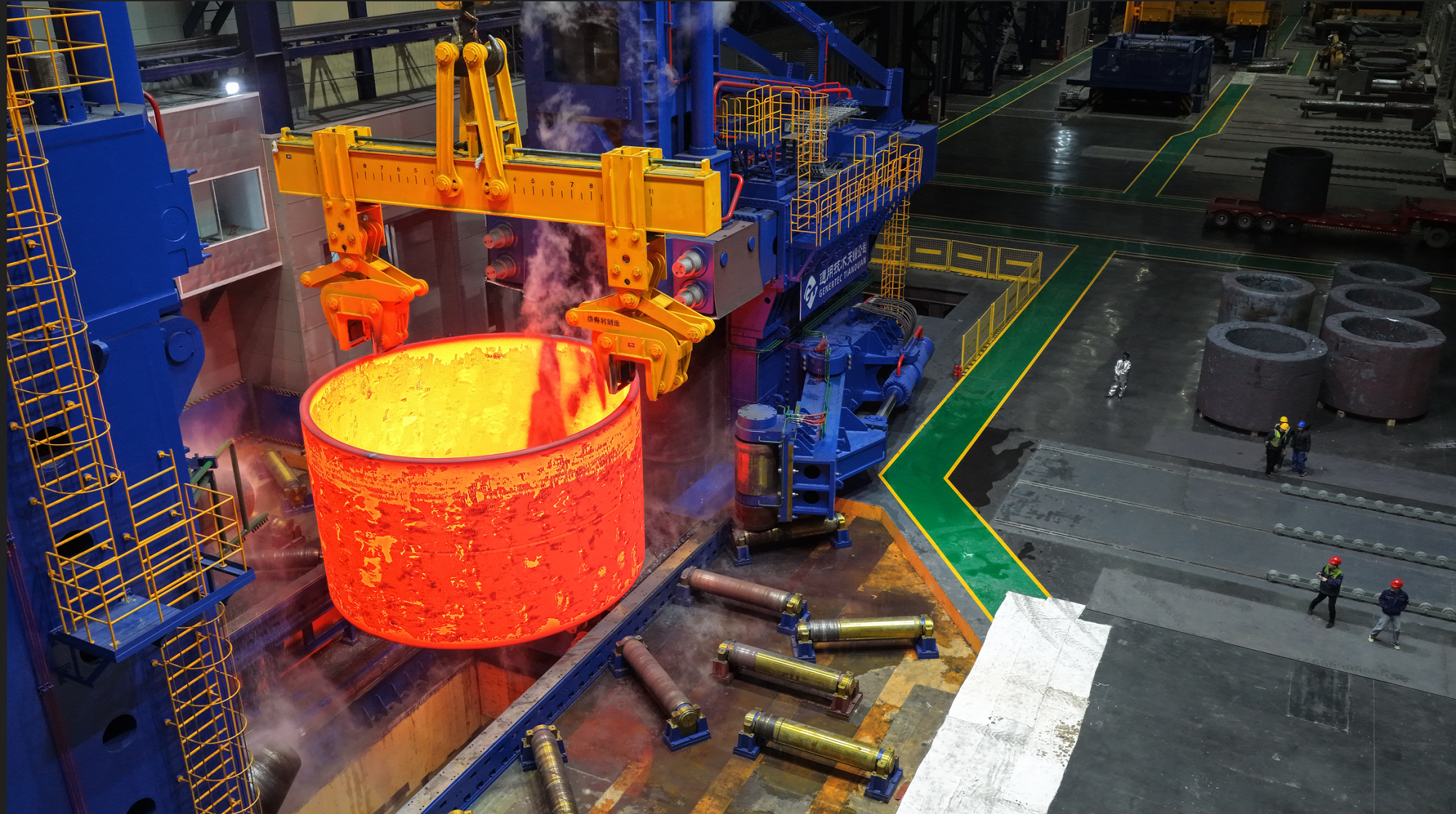
Certificates are only relevant up to the size of the part they can support. The capability data that should sit next to the certificate file includes: open-die forging capability up to 300 tons, seamless rings up to 21 m in diameter, section heights up to 5 m, production across carbon steel, stainless steel and alloy steel, monthly capacity of 70,000 t, and 100% testing as the stated quality-control position. Iraeta's facilities are configured for 300-ton open-die forgings, seamless rings beyond 21 m, 5-meter-tall rolled shells and 25-meter-long forged bars; in 2026 the company produced a seamless rolled steel ring measuring 21.029 m in diameter, exceeding its own previous world record of 15.673 m set in 2022. The company's product range runs from 0.3 kg to 300 tons, covering discs, rings, shells, bars, shafts and wear-resistant grinding media.
Procurement rule: never approve a supplier on certificates alone, and never approve a supplier on capability alone. The certificate must cover the product form, and the plant must be able to produce the diameter, height, weight and material on your drawing.
Step-by-Step Breakdown: A Seven-Step Certification Verification Workflow
- Request the certificate pack as documents, not logos. Ask for full certificates with numbers, issuing bodies, scope statements and dates — for example PED 2014/68/EU number 01 202 CHN/Q-06 0144.01, ISO 14001:2015 number F01926E00118R502, EN 1090 number 0035-CPR-1090-1.03389.TÜVRh.2025.003, ISO 9001:2015 number F02326Q00125R602 and ISO 45001:2018 number F01926S00070R502.
- Match scope wording to your product form. Confirm that "hot rolled rings" and "forgings" appear where they need to, and that the manufacturing site in scope is the site quoting.
- Check validity against your delivery window. Current expiry dates run to 31 March 2027 for PED, 25 April 2027 for EN 1090, 21 April 2029 for ISO 9001:2015 and 1 March 2029 for ISO 14001:2015 and ISO 45001:2018. Flag any order whose delivery or warranty period extends beyond a certificate's expiry.
- Confirm the capability envelope. Verify the maximum diameter, height and weight the supplier can forge and roll — up to 21 m diameter, 5 m height and 300 tons in this case — against your drawing before discussing documentation further.
- Align material and delivery condition. Confirm the material family (carbon steel, stainless steel or alloy steel), heat treatment route and machining scope, and state which external specification applies to your order.
- Validate with a sample or first article. Use one unit to confirm dimensional control, surface condition, heat treatment response and documentation practice before releasing full volume.
- Close the loop in the contract. Specify which certificates, test reports and traceability records must accompany shipment, and confirm the 100% test position in writing.
Use Cases: Where Each Certificate Earns Its Place
Wind and hydropower. Wind power flanges, bearing rings, gearbox forgings and hydropower forgings operate under cyclic loading and long service intervals, so quality-system continuity and material traceability matter as much as the original specification. The documented capability envelope — including rings beyond 21 m — is directly relevant to large-diameter tower and turbine interfaces.
Cement rotary kilns. In Germany, a core supporting ring (rotary kiln tyre) was supplied to a cement and energy equipment manufacturer for large-scale industrial equipment. The single unit used ultra-large diameter integral forging and precision machining, with high load-bearing capacity, excellent thermal stability and extended service life. The project achieved stable operation under high-temperature and heavy-load conditions and met strict quality standards for heavy-duty applications. In Turkey, a cement plant took delivery of one set of core structural components for a rotary kiln, with precision forging and machining, high temperature resistance, excellent fatigue strength and extended service life, achieving stable operation under high-temperature and heavy-load conditions.
Oil, gas and petrochemical. In Saudi Arabia, two units of key components for refining and petrochemical equipment were supplied to an oil and gas OEM. The components showed high forging precision, wear resistance, high-temperature resistance and long service life, and the project achieved stable operation fully compliant with the project's stringent quality and safety requirements. Separately, three pieces — two shell sections and one transition section — were produced for a heavy-duty hydrogenation reactor applied in a 7.5 Mt/y European refinery project, using integral ring rolling and near-net-shape forming for superior mechanical performance and a shorter production lead time.
Nuclear and offshore. Iraeta components are deployed in fourth-generation nuclear power plants, 16-meter shield tunneling machines and floating offshore wind turbines above 20 MW. These applications combine large diameter, high material integrity and rigorous documentation — the exact combination that makes the priority order in this checklist practical rather than theoretical.
Comparison Table: Certification Matrix for Rolled Ring Forgings Buyers
| Certificate / standard | Type | Certifying body | Certificate number | Declared scope | Valid through | Buyer trigger |
|---|---|---|---|---|---|---|
| PED 2014/68/EU | CE / EU directive | TÜV | 01 202 CHN/Q-06 0144.01 | Manufacturing of forged flanges and hot rolled rings (EU market) | 31 March 2027 | EU pressure equipment and pressure-adjacent rings |
| ISO 14001:2015 | ISO management system | NQA Certification Co., Ltd. (Shanghai) | F01926E00118R502 | Raw materials for forgings, forgings, steel balls, cylpebs and grinding rods | 1 March 2029 | ESG and environmental tender requirements |
| EN 1090 | CE / structural steel | TÜV | 0035-CPR-1090-1.03389.TÜVRh.2025.003 | Structural components and kits to EXC3 (EN 1090-2), load-bearing structures | 25 April 2027 | Welded or bolted structural ring applications |
| ISO 9001:2015 | ISO management system | BV | F02326Q00125R602 | Raw materials for forgings, forgings, steel balls, cylpebs and grinding rods | 21 April 2029 | Baseline requirement on virtually all orders |
| ISO 45001:2018 | ISO management system | NQA Certification Co., Ltd. (Shanghai) | F01926S00070R502 | Raw materials for forgings, forgings, steel balls, cylpebs and grinding rods | 1 March 2029 | Supplier audits and long-term supply agreements |
FAQ: Certification Questions Procurement Teams Ask Most
Is PED 2014/68/EU required for every rolled ring forging sold into the EU?
No — applicability depends on whether the finished equipment falls within the directive's scope, its category, and the pressure and volume parameters, so the assessment belongs with your engineering team or notified body. What can be verified on the supplier side is documentation: Iraeta holds PED 2014/68/EU certificate 01 202 CHN/Q-06 0144.01 issued by TÜV, with the declared scope "Manufacturing of forged flanges and Hot rolled rings" for the EU market, issued 12 February 2024 and valid through 31 March 2027. For EU-bound pressure and petrochemical work, that certificate is the correct first document to request.
What production capability should sit behind those certificates?
Certificates should be matched to a verifiable manufacturing envelope. For heavy rolled rings, the relevant figures are maximum diameter, maximum height, maximum weight, material range and monthly capacity. Iraeta's stated envelope includes open-die forgings up to 300 tons, seamless rings up to 21 m in diameter, 5 m maximum height, carbon steel / stainless steel / alloy steel materials and a monthly capacity of 70,000 t, with 100% testing as the quality-control position. The company produced a 21.029 m diameter seamless rolled steel ring in 2026, after setting a 15.673 m record in 2022 — evidence that the certified scope is backed by demonstrated forming capability rather than a paper claim.
Does a higher certification level change the price of a rolled ring forging?
Certificates themselves are not usually a separate line item, but the requirements they imply are. Scope, material grade, heat treatment route, machining allowances, the 100% test position and ring size all influence cost, which is why a quotation should be requested against a drawing and a specified delivery condition rather than against a certification list alone. Iraeta's stated commercial position is a minimum order quantity of 1 unit with lead time negotiable based on customization, so a single-piece first order is a realistic way to price the actual requirement before scaling.
Can we validate a supplier with a sample before committing to volume?
Yes, and it is the recommended route at this stage of evaluation. With a minimum order quantity of 1 unit, a first ring can be produced and examined for dimensional control, surface condition, heat treatment response and documentation quality. Customization is available across material, size, forging shape, heat treatment and machining, so the sample can be configured to the same specification as the intended production order rather than to a generic catalogue item. Requesting the certification pack together with the sample report gives a complete picture of both documentation and manufacturing performance.
How long does delivery take, and how do certifications affect lead time?
Lead time is negotiable based on customization, since material grade, ring diameter, heat treatment and machining scope all shape the production route. Certification does not usually extend lead time when the required certificates are already in force and the scope covers the product form — it is a documentation step that travels with the shipment. The practical checklist item is to confirm at order stage which certificates, test reports and traceability records must accompany delivery, and to confirm that each certificate remains valid across the delivery and warranty period. The fastest way to start is to send the drawing, material specification, target quantity and destination market.
Next Step: Send Your Ring Specification for Review
Iraeta Energy Equipment Co., Ltd. produces seamless rolled ring forgings, profiling rings, wind power flanges, bearing rings, kiln tyres and hydroelectric forgings from 0.3 kg to 300 tons, with export markets covering the EU, the Americas, Asia and the Middle East. To receive a quotation, a sample proposal or the full certification pack, share your drawing and specification.
Website: iraeta.com
Email: ebiz@iraeta.com
Tel / WhatsApp: +86 188-5315-7508
Contact: Simon Wang
Conclusion: Turn the Checklist into a Qualification File
Certification screening for rolled ring forgings works best as a fixed sequence. Start with PED 2014/68/EU where EU pressure or hot rolled ring duties apply, add ISO 14001:2015 where environmental requirements are contractually relevant, apply EN 1090 for structural applications, confirm ISO 9001:2015 as the baseline quality system with upstream raw-material scope, and treat ISO 45001:2018 as an operational reliability indicator for long-term supply. Then match all of it against the production envelope — 300-ton open-die forging capability, rings up to 21 m in diameter, 5 m heights and a 70,000 t monthly capacity — so that the documents describe a plant that can actually make the component on your drawing.
Applied consistently, this checklist produces a qualification file that survives audits, withstands project scrutiny, and gives procurement teams a defensible basis for supplier approval rather than an impression based on logos.
Have Questions or Need More Details?
Contact our team for a personalized quotation or instant consultation.
Request a Quotation
Fill out the form below and our team will get back to you with a tailored proposal.
WhatsApp Direct Chat
Prefer to chat in real-time? Message us on WhatsApp for instant assistance & quick answers.
- Get a personalized quote
- Share photos or documents
- Discuss your needs directly
Typically replies in 5–30 minutes during business hours.