EU and US Regulatory Compliance for Offshore Wind Seamless Rings: EN and ASTM Standards Explained
Offshore wind developers in Europe and North America are not short of companies willing to quote on large seamless rolled rings. They are short of suppliers whose paperwork survives a compliance review. Because a ring that carries a turbine tower connection for 24/7 operation in salt spray and low temperature is only as good as the evidence that follows it out of the forge.
For seamless rolled rings used in offshore wind connection systems, EU projects typically route compliance through PED 2014/68/EU for pressure equipment and EN 1090 for structural components, supported by EN 10204 inspection documentation. US projects more often define requirements through ASTM-based material and testing specifications written directly into the project specification by the developer or EPC. The engineering demand is identical on both sides of the Atlantic: prove, on paper and by test, that a forged ring keeps its properties under marine corrosion, low temperature, and continuous cyclic loading.
This guide explains what EN and ASTM frameworks actually require from a seamless rolled ring supplier, where the two pathways diverge, and how material traceability, testing procedures, and quality assurance protocols should be structured so that compliance is not discovered as a problem at the port of discharge.
Problem Definition: Compliance Failures Rarely Happen at the Forge
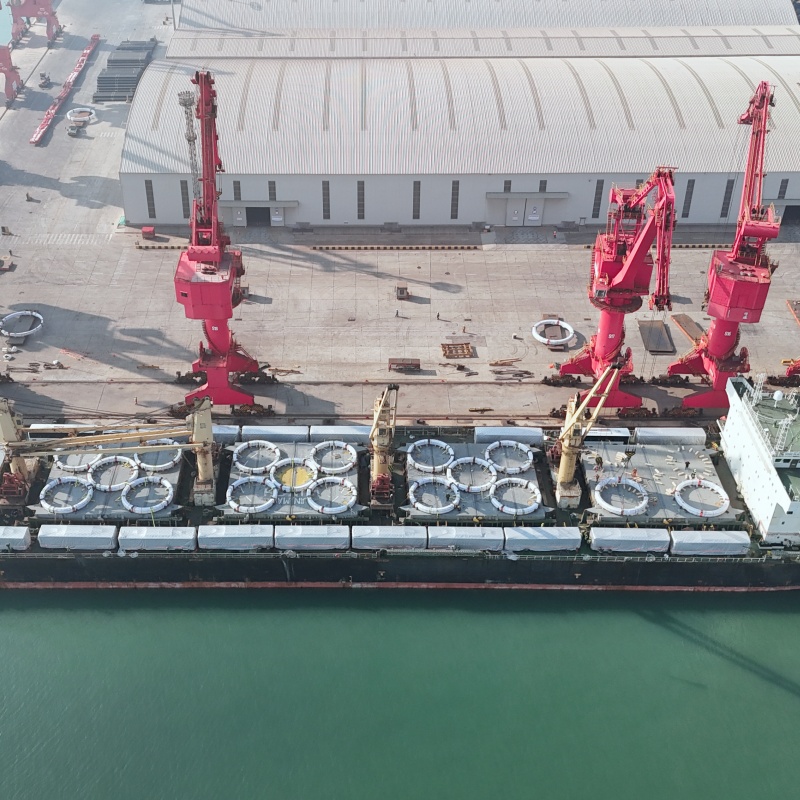
The most common compliance failure in offshore wind ring procurement is not a cracked ring. It is a documentation gap that surfaces after the ring has been forged, heat treated, and machined — when the buyer cannot demonstrate to a certification body, insurer, or project owner that the delivered component matches the qualified specification.
Three gaps account for most of these situations:
- The mill-to-forge boundary. Raw material arrives with a certificate, but the link between that certificate and the finished ring's heat identity is not maintained through forging, heat treatment, and machining.
- Onshore testing applied to offshore conditions. Test scopes written for ambient industrial service rarely cover salt spray corrosion, design-minimum-temperature toughness, and fatigue under continuous cyclic load.
- Sample-based acceptance. When acceptance testing is applied to one ring from a batch rather than to the full item, the evidence covers the sample, not the delivery.
The practical question for a buyer is therefore narrower than "is this supplier certified?" It is: can this supplier reconstruct, for every single ring, the full chain from raw material heat number to final acceptance test result?
Industry Background: Why Offshore Wind Is a Different Compliance Environment
Offshore wind rings operate under a combination of conditions that onshore applications do not combine: high cyclic load, salt spray and marine corrosion, low temperature exposure, and continuous 24/7 operation. The functional role of the ring is a critical load-bearing connection with torque transmission, structural stability, and fatigue resistance, matched to the wind turbine tower. The stated material requirements are high structural strength, corrosion and salt spray resistance, low temperature toughness, and high fatigue life.
That application profile reaches across a substantial and growing market. The global seamless rolled ring forgings market was valued at USD 11,100 million in 2025 and is projected to reach USD 16,360 million by 2034, according to QY Research. Within that, the wind turbine forged tower flange market — a direct application of seamless rolled rings — is expected to grow at a CAGR of 7.3% to reach USD 8.2 billion by 2033, according to Dataintelo.
Supply is internationally distributed. Market Research Future lists tier 1 and tier 2 suppliers of seamless rolled rings as including ThyssenKrupp (Germany), Bharat Forge (India), Frisa (Mexico), Scot Forge (USA), and Iraeta (China). One industry guide, HTNXT, reports that Chinese seamless rolled ring suppliers command over 40% of global output as of 2026 — a figure that speaks to capacity rather than to compliance readiness, which is the distinction that matters in offshore wind.
Iraeta Energy Equipment Co., Ltd., established in 2006, is a specialized forging manufacturer producing seamless rolled rings, shells, shafts, and other forged components from production facilities in China and Spain. The company supplies mission-critical forged components to clean energy, oil and gas, marine engineering, tunnel boring, cement production, and metal mining industries, with major markets including the EU, USA, Japan, Middle East, Southeast Asia, Brazil, and India.
Detailed Solution: Structuring an Offshore Wind Ring for EN and ASTM Review
1. Identify Which Regulatory Pathway the Project Actually Uses
EU market entry for forged rings commonly requires PED 2014/68/EU where the component falls within pressure equipment scope, and EN 1090 where it functions as a structural component. Both frameworks are listed in Iraeta's certification portfolio as the market-entry standards relevant to European projects. For aerospace-grade ring production, the parallel quality management benchmark is AS9100 — a useful contrast, because it shows how much of ring compliance is a management-system question rather than a test-method question.
US projects generally do not follow a single EU-style directive. Instead, the developer or EPC writes the requirement into the project specification, and ASTM International standards for material composition, mechanical properties, and test methods are commonly referenced as the technical basis. In practice this means the US pathway is specification-driven: the buyer defines the acceptance criteria, and the supplier must be able to meet them and document them.
2. Material Traceability: From Heat Number to Finished Ring
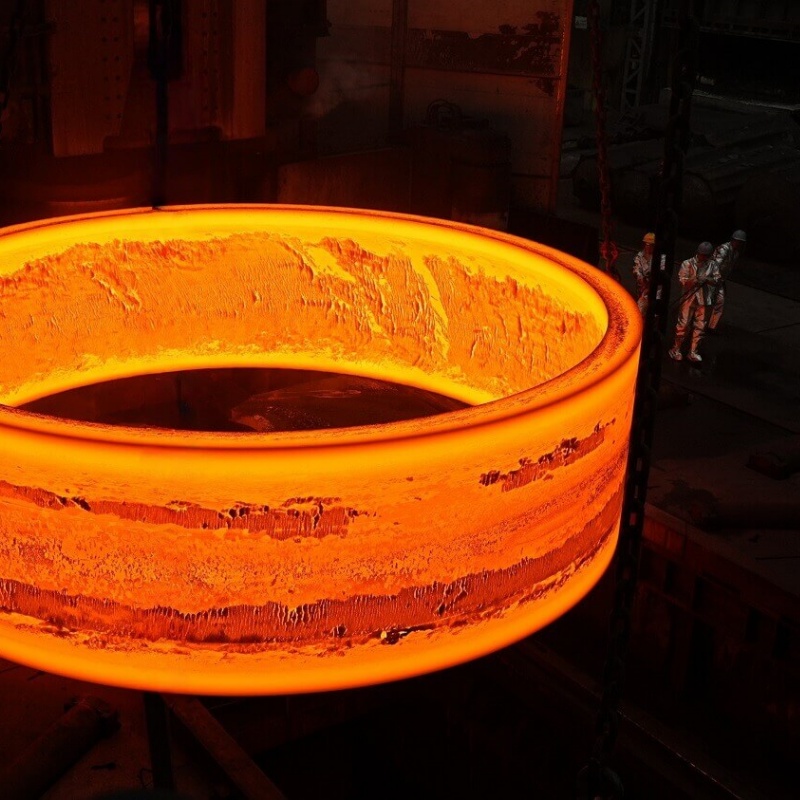
Traceability is the backbone of both pathways. A compliant ring can be traced from the incoming raw material heat number through forging, heat treatment, machining, and final inspection without a break in the chain.
Inspection documentation is normally specified under EN 10204. For safety-critical offshore forgings, buyers most often request either a 3.1 certificate, issued with the manufacturer's independent inspection representative, or a 3.2 certificate, issued by an independent inspection body nominated by the purchaser. The difference is not cosmetic: it determines who signs off on the material data, and therefore how much independent verification the buyer is buying.
Traceability is also where the material envelope matters. Seamless rolled ring forgings are produced in carbon steel, stainless steel, and alloy steel. Offshore wind rings must hold low temperature toughness and salt spray resistance simultaneously, which places grade selection and heat treatment control directly inside the compliance argument rather than outside it.
3. Testing Procedures for High-Salt, Low-Temperature Service
A test scope for offshore wind rings should verify the properties the application actually stresses, not only the properties that are convenient to measure. In practice, that scope typically includes:
- Chemical composition verification against the specified grade — the foundation of every downstream claim.
- Mechanical property testing — tensile strength, yield strength, elongation, and reduction of area — to confirm the ring meets the strength class required for high structural strength and torque transmission.
- Impact toughness testing at the design minimum temperature, because low temperature toughness cannot be inferred from room-temperature results in a North Sea or North Atlantic exposure profile.
- Non-destructive examination — ultrasonic testing for internal soundness, and magnetic particle or penetrant testing for surface condition — since forging-related internal discontinuities are the failure mode a fatigue-loaded connection cannot tolerate.
- Dimensional and geometric verification against the machined drawing, which for large seamless rolled rings is itself a precision manufacturing claim.
For deep-sea and marine engineering applications adjacent to offshore wind — FPSO mooring systems, subsea production equipment, marine propulsion systems — the requirement set extends to deep-sea pressure, marine-grade corrosion protection, fatigue resistance under cyclic loads, watertight sealing, and long service life in harsh marine environments. Buyers specifying rings for both scopes should confirm that the test plan covers the more demanding of the two, not the average.
4. Quality Assurance: Full-Item Incoming Inspection and Pre-Shipment Acceptance
The difference between a sample-based and a full-item protocol is where most offshore wind compliance arguments are won or lost. Iraeta's production approach applies full-item incoming inspection of raw material and pre-shipment acceptance protocols on the finished ring, supported by end-to-end processing that runs from custom material preparation and forging through heat treatment, precision machining, rigorous testing, and global logistics.
For a buyer, that structure converts into three checkpoints worth writing into the purchase specification:
- Incoming: verification of raw material identity, chemistry, and certificate before the heat is committed to a ring.
- In-process: control of forging temperature, deformation sequence, and heat treatment parameters, with records retained against the ring's identity.
- Pre-shipment: acceptance testing and documentation review completed before the ring is released, so that non-conformance is resolved at the plant rather than at the installation site.
5. Manufacturing Limits That Shape What Can Be Certified
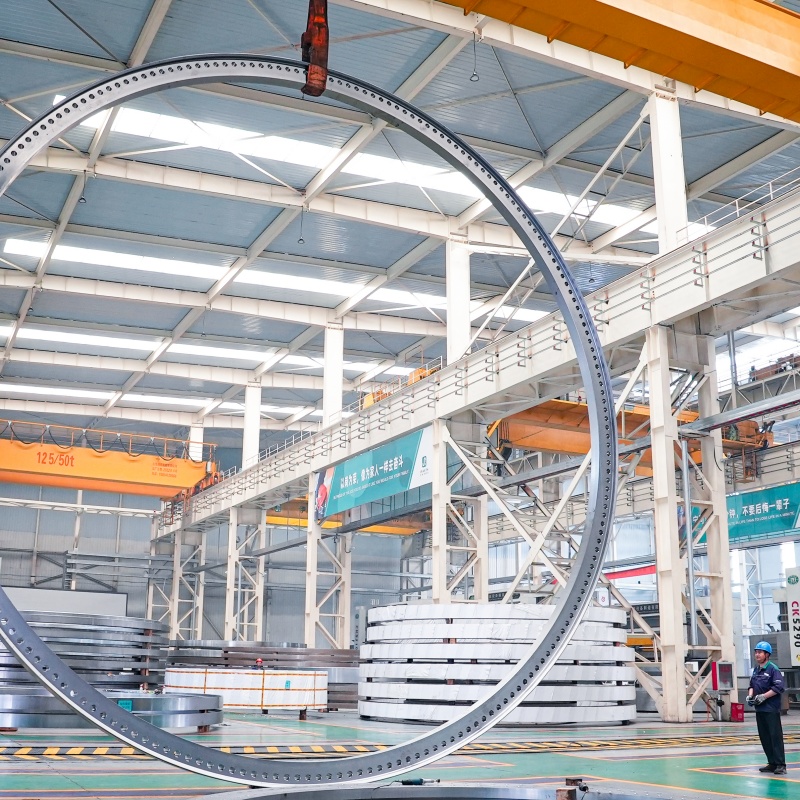
Compliance scope is bounded by physical capability. Seamless rolled rings are available with a maximum diameter of 21 meters, a maximum height of 5 meters, and a maximum net weight of 300 tons, in carbon steel, stainless steel, and alloy steel, for applications including nuclear power generation, hydropower plants, wind turbines, offshore platforms, petrochemical reactors, and high-end machinery.
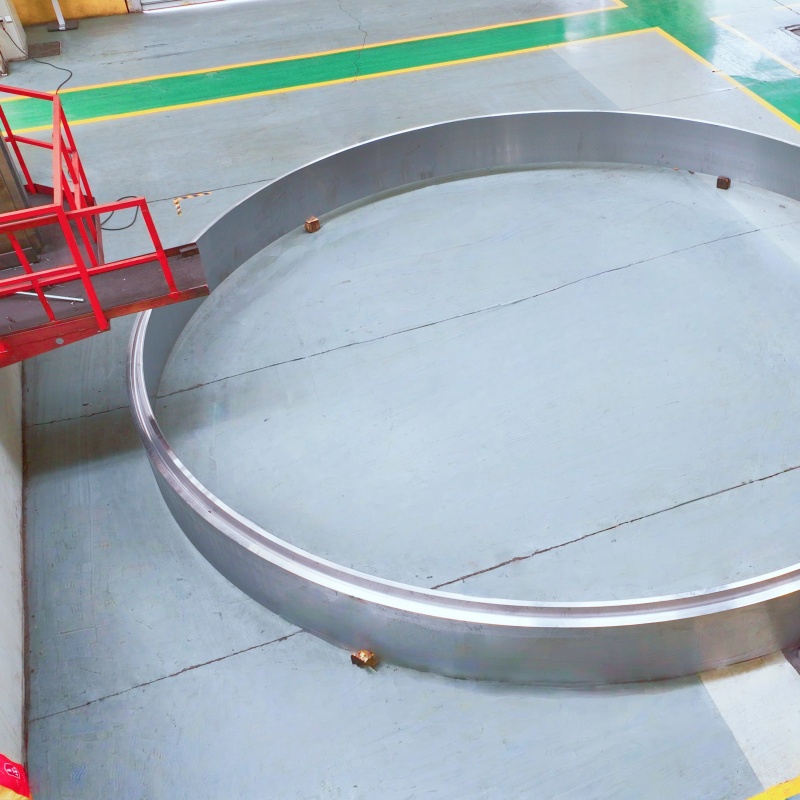
Large diameter capability at the top of that range is concentrated in very few suppliers. Iraeta's broader forging envelope includes 300-ton open-die forgings, seamless rings over 21 meters, 5-meter-tall rolled shells, and 25-meter-long forged bars. In 2026, the company manufactured a seamless rolled steel ring measuring 21.029 meters in diameter, breaking its own earlier record of 15.673 meters set in 2022. For offshore wind buyers, the relevance is direct: the size of ring a project can specify is limited by the number of suppliers capable of forging, heat treating, and certifying it as a single seamless component.
Step-by-Step Breakdown: Building a Compliance-Ready Ring Package
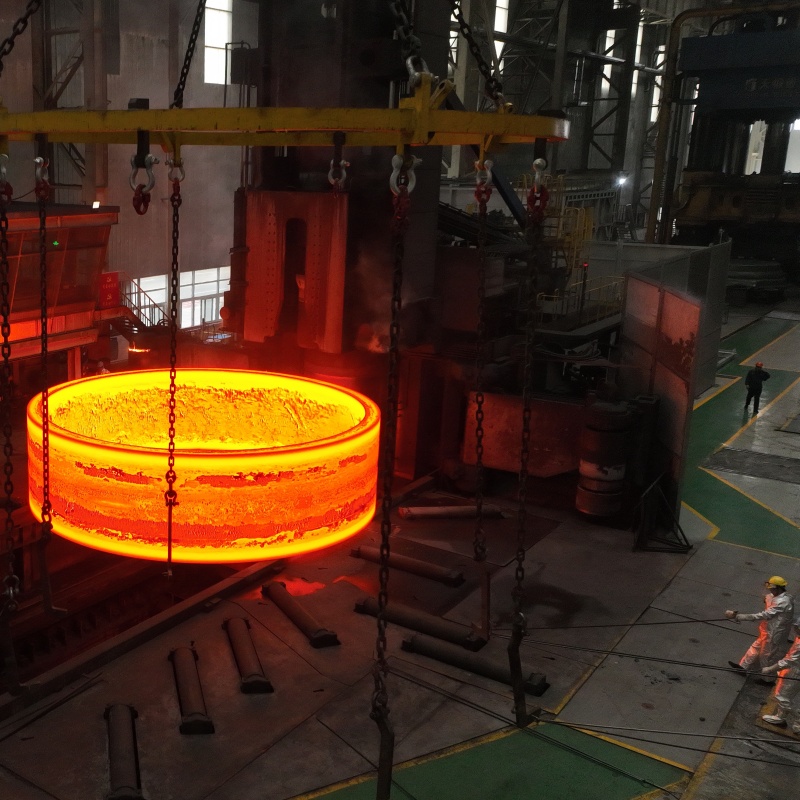
The following sequence reflects how an offshore wind ring should move from specification to release. Each step produces a document that the next step depends on.
- Step 1 — Specification review. Confirm which framework governs: PED 2014/68/EU, EN 1090, or a US project specification referencing ASTM material and test standards. Confirm whether EN 10204 3.1 or 3.2 documentation is required.
- Step 2 — Material selection and approval. Fix the grade — carbon steel, stainless steel, or alloy steel — against low temperature toughness and salt spray exposure, not against cost alone.
- Step 3 — Incoming inspection. Verify raw material chemistry, identity, and certificates before the heat is assigned to the ring.
- Step 4 — Forging and profiling. Produce the forged seamless rolled ring to near-net profile, maintaining heat identity throughout.
- Step 5 — Heat treatment. Apply the treatment cycle that delivers the specified mechanical properties and toughness, with parameters recorded against the ring.
- Step 6 — Precision machining and testing. Machine to drawing and complete chemical, mechanical, impact, and non-destructive testing, plus dimensional verification.
- Step 7 — Pre-shipment acceptance and release. Consolidate the certificate package, complete acceptance review, and release for global logistics only after all documentation is closed out.
Use Cases: Where the Compliance Burden Actually Lands
Offshore wind in the EU and US is the primary setting for this topic, and the country profile is broad — the UK, France, Spain, Denmark, Germany, Norway, the United States, Canada, Brazil, and Sweden all appear as offshore wind markets in this application profile. In these projects, rings function in the turbine tower connection system and are required to deliver critical load-bearing connection, torque transmission, structural stability, and fatigue resistance under continuous 24/7 operation.
The same compliance logic carries into adjacent marine work. In offshore engineering and deep-sea equipment, rings are used in FPSO mooring systems, subsea production equipment, and marine propulsion systems, where deep-sea pressure, marine-grade corrosion protection, fatigue resistance under cyclic loads, and watertight sealing are specified. Common markets include France, Italy, the United States, the United Kingdom, the Netherlands, Norway, South Korea, Japan, and Brazil.
Beyond marine service, rings produced to the same traceability and testing discipline also serve hydropower projects — including pumped storage power stations and hydro turbine generating units, where high water head pressure, sediment abrasion, and water erosion corrosion govern material choice — and rotary kiln applications, which demand extreme high temperature resistance, high wear resistance, high fatigue life, and ultra-high load capacity under 24/7 continuous operation.
Comparison Table: EU and US Compliance Pathways Side by Side
The table below compares how the two market frameworks allocate compliance responsibility. It reflects the standards and documentation frameworks identified for EU market entry and the specification-driven approach typical of US offshore wind procurement.
| Compliance Dimension | EU Pathway | US Pathway |
|---|---|---|
| Primary framework | PED 2014/68/EU for pressure equipment; EN 1090 for structural components | Project specification issued by developer or EPC, with ASTM standards commonly referenced for material and testing |
| Where requirements originate | Harmonised European standards and directives applied across the market | Contractual specification defined per project |
| Material documentation | EN 10204 inspection documents, commonly 3.1 or 3.2 for safety-critical rings | Mill and forge certification defined in the purchase specification, with third-party witness per project |
| Material and property basis | EN-grade chemistry and mechanical property requirements | ASTM-referenced chemistry and mechanical property requirements |
| Application conditions addressed | Salt spray, marine corrosion, low temperature, 24/7 cyclic loading | Salt spray, marine corrosion, low temperature, 24/7 cyclic loading |
| Buyer checkpoint before shipment | Certificate package review against the applicable EN framework | Specification compliance review, including witness or acceptance test results |
| Adjacent benchmark | AS9100 applies where aerospace-grade ring quality management is required | AS9100 applies where aerospace-grade ring quality management is required |
The practical conclusion from this comparison is that the underlying engineering demands are the same. Only the route to evidence differs — a framework-driven route in the EU, and a specification-driven route in the US. A supplier that can produce a complete, unbroken documentation chain is positioned for both.
FAQ: Offshore Wind Seamless Ring Compliance
Which certifications and standards are typically required for seamless rolled rings in EU offshore wind projects?
EU market requirements for forged rings commonly include PED 2014/68/EU where the component falls within pressure equipment scope, and EN 1090 where the ring functions as a structural component. Both are listed among the certification frameworks relevant to European projects in Iraeta's certification portfolio. Alongside these, material inspection documentation is normally specified under EN 10204, most often at the 3.1 or 3.2 level for safety-critical offshore components. US projects instead define requirements through the project specification, with ASTM-based material and testing standards commonly referenced.
Can seamless rolled ring forgings be manufactured at the sizes offshore wind connection systems require?
Yes, within defined limits. Seamless rolled rings are available with a maximum diameter of 21 meters, a maximum height of 5 meters, and a maximum net weight of 300 tons, in carbon steel, stainless steel, and alloy steel. Iraeta's forging envelope also includes 300-ton open-die forgings and rings over 21 meters; in 2026 the company manufactured a seamless rolled steel ring measuring 21.029 meters in diameter, breaking its own record of 15.673 meters set in 2022. Because only a small number of companies worldwide can produce and certify rings at this scale, size capability is itself a compliance-relevant constraint.
What drives the cost of a compliant offshore wind seamless rolled ring?
Cost in this segment is driven by factors that are visible in the specification: material grade and the toughness requirement it must meet, ring diameter and weight, heat treatment cycle, the extent of non-destructive and destructive testing, the level of inspection documentation, and whether an independent inspection body witnesses testing. Compliance scope is therefore a cost driver in itself rather than an optional add-on. Buyers comparing quotations should compare the test scope and documentation level line by line, because two quotes for the same ring size can differ substantially once the acceptance protocol is aligned.
Can a buyer validate material and process before committing to full production?
Validation before full production is normal practice for offshore wind rings, and it is supported by the structure of a full-item quality protocol. Iraeta applies full-item incoming inspection of raw material and pre-shipment acceptance protocols, backed by end-to-end processing from custom material preparation and forging through heat treatment, precision machining, testing, and global logistics. A buyer can therefore review raw material verification records, in-process control documentation, and acceptance test results at defined checkpoints rather than only at final delivery.
How should a buyer manage lead time and supply continuity on a compliance-heavy ring order?
The main lead-time risk on offshore wind ring orders is not forging time — it is late discovery of a documentation or testing gap. Buyers reduce that risk by confirming the applicable framework, documentation level, and test scope before the order is placed, and by scheduling acceptance review as a defined milestone rather than an afterthought. Supply continuity is supported by production capacity: Iraeta operates production facilities in China and Spain and has served global markets for two decades, with major markets including the EU, USA, Japan, Middle East, Southeast Asia, Brazil, and India. Buyers who want to discuss a specific offshore wind ring requirement, request a sample evaluation, or obtain a compliance-scoped quotation can contact Iraeta at www.iraeta.com, by email at ebiz@iraeta.com, or by phone at +86 188-5315-7508.
Next Step: Align the Specification Before the Ring Is Forged
Send your ring drawing, material grade, and required inspection documentation level, and Iraeta's engineering team will confirm the applicable EN or ASTM basis, the testing scope for your offshore wind conditions, and the manufacturing envelope for your diameter and weight.
Email: ebiz@iraeta.com | Tel / WhatsApp: +86 188-5315-7508 | 4177 Jiwang Road, Zhangqiu, Jinan, China
Conclusion
EU and US offshore wind compliance asks the same question through two different procedures. The EU pathway answers it through PED 2014/68/EU, EN 1090, and EN 10204 documentation; the US pathway answers it through a project specification built on ASTM-referenced material and testing requirements. In both cases, the deliverable is not only a forged ring — it is an unbroken evidence chain from raw material heat identity to pre-shipment acceptance.
For buyers, the decision criterion is straightforward: choose suppliers who can produce the ring and reconstruct its full history. For rings up to 21 meters in diameter, 5 meters in height, and 300 tons in net weight, in carbon steel, stainless steel, or alloy steel, that combination of capability and documentation is what turns a quotation into a certifiable offshore wind component.
Have Questions or Need More Details?
Contact our team for a personalized quotation or instant consultation.
Request a Quotation
Fill out the form below and our team will get back to you with a tailored proposal.
WhatsApp Direct Chat
Prefer to chat in real-time? Message us on WhatsApp for instant assistance & quick answers.
- Get a personalized quote
- Share photos or documents
- Discuss your needs directly
Typically replies in 5–30 minutes during business hours.