Rolled Ring Forgings Technical Guide: Parameter Selection for Extreme Service
Short answer: For rolled ring forgings in extreme service, the operating environment — not the drawing alone — decides which material, geometry, heat-treatment and testing parameters matter most. Offshore wind loads a ring with cyclic stress, salt spray and low-temperature exposure; hydropower loads it with high water-head pressure and fatigue; a rotary kiln loads it with extreme heat, 24/7 thermal cycling, dust corrosion and thermal expansion. Iraeta Energy Equipment Co., Ltd. (Iraeta) forges rings from 0.3 kg to 300 tons — including 300-ton open-die forgings, seamless rings over 21 meters in diameter, rolled shells up to 5 meters tall and forged bars up to 25 meters long — using integral ring rolling and near-net-shape forming to match those conditions.
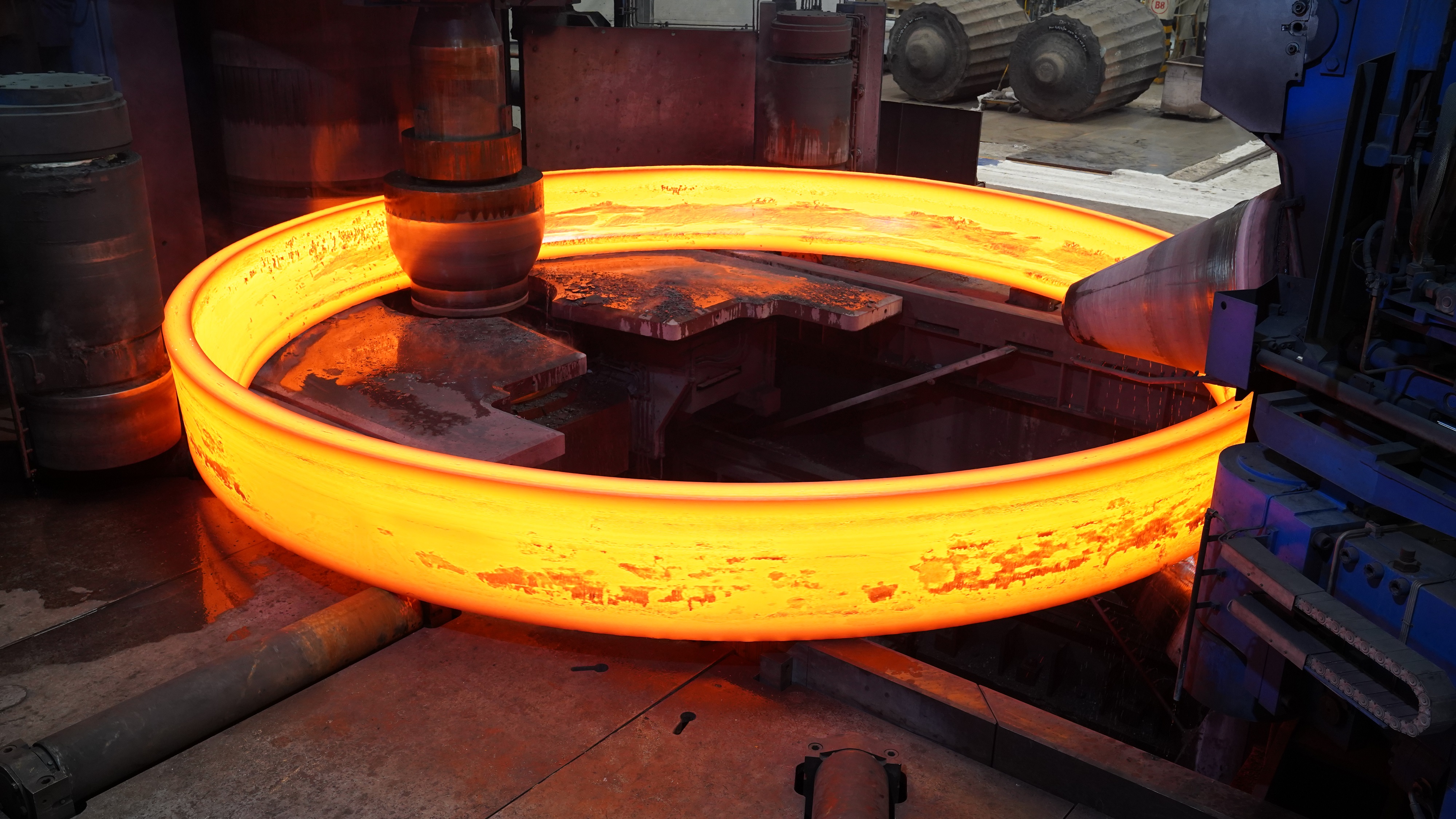
Transition section forged for a heavy-duty hydrogenation reactor — an example of integral ring rolling and near-net-shape forming for high-demand service.
What "Extreme Service" Actually Means for a Rolled Ring
A rolled ring forging is a seamless metal ring produced by piercing, upsetting and ring rolling a heated billet until the wall thickness and diameter reach the required profile. Because the grain flow follows the circumference, a properly rolled ring resists hoop stress more predictably than a welded or cast equivalent.
"Extreme service" is a working label, not a standard. It describes service conditions in which ordinary design margins are insufficient, and where at least two of the following act at the same time:
- High or reversed cyclic mechanical load (fatigue-driven).
- Corrosive atmosphere or immersion, including salt spray and marine corrosion.
- Low-temperature exposure that raises the risk of brittle behaviour.
- Sustained high temperature combined with repeated heating and cooling.
- Abrasive or chemically aggressive process media, such as cement dust.
Why Standard Parameter Assumptions Break Down
Most generic purchasing checklists treat ring parameters as independent variables: diameter, wall thickness, weight, material grade, tolerance. In extreme service, those variables interact, and the interaction is what causes early failure.
Three failure patterns worth designing against:
- Fatigue before overload. A ring under repeated load can crack below its static strength limit. Surface condition, internal soundness and grain flow all influence how long it takes.
- Corrosion-assisted cracking. Salt spray and marine corrosion reduce the effective fatigue life of a component that would otherwise be acceptable.
- Thermal distortion. Under 24/7 cycling, uneven thermal expansion changes contact geometry over time, which changes load distribution.
This is why the same nominal ring size can behave very differently in offshore wind, hydropower and cement. The buyer's real task is not to specify a bigger ring — it is to specify the right parameter hierarchy for the operating condition.
Industry Background
Rolled ring forgings sit inside a broader metal-forming market that continues to expand with heavy industry. The global ring rolling products market was valued at USD 4.56 billion in 2025 and is projected to reach USD 7.35 billion by 2035, according to the Ring Rolling Product Market Size, Trend & Forecast 2025 to 2035 report. Seamless rolled rings represent approximately 24% of global manufactured forging components by production volume, per the Forging Market Trends and Growth Analysis Report To 2035.
Demand is concentrated where rotating and load-bearing equipment operates continuously. The wind turbine forging market alone was valued at USD 9.6 billion in 2024, with onshore segments holding a 67.3% share, according to Global Market Insights — a signal that even land-based wind fleets are a major consumer of large forged rings and flanges.
On the material side, carbon steel accounts for approximately 38.2% of raw material share in the global metal forging market (Dataintelo), which reflects a simple economic reality: for many heavy components, carbon and low-alloy steels remain the default choice, with alloy or stainless grades selected only where corrosion or temperature justifies the cost.
Two standards frequently referenced in pressure- and temperature-related forging work are ASTM A182, the specification for forged or rolled alloy and stainless steel pipe flanges and parts for high-temperature service, and EN 10222-2, which specifies technical delivery conditions for ferritic and martensitic steel forgings for pressure purposes. Buyers who understand these frameworks can ask sharper questions of any supplier.
How Operating Conditions Drive Parameter Selection
The core of this guide is a simple translation exercise: read the service environment, then set the parameters that the environment actually punishes.
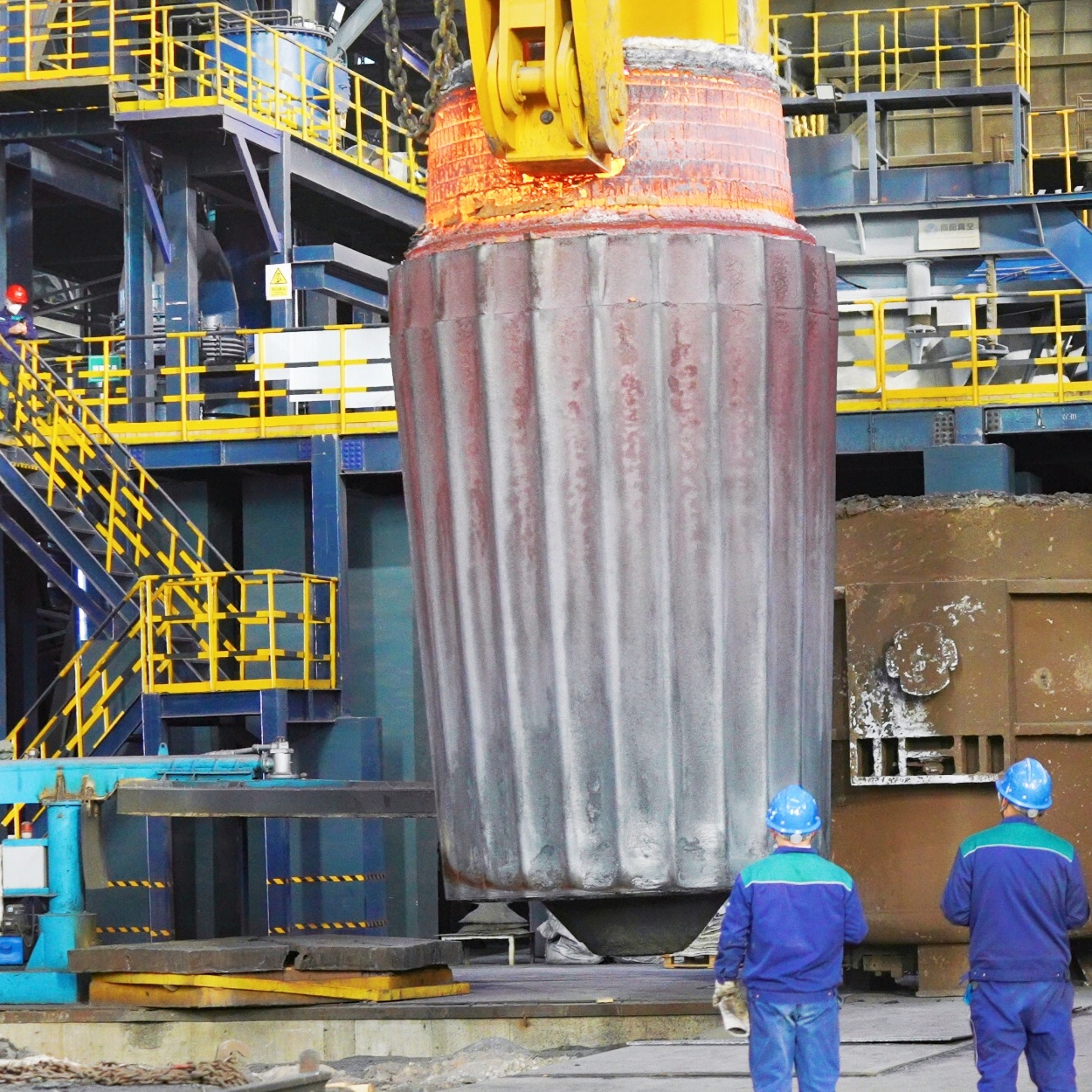
Raw material preparation for forgings at the 300-ton scale — the starting point for extreme-service ring selection.
Offshore Wind: Cyclic Load, Salt Spray, Marine Corrosion and Low Temperature
Offshore wind components face a combined attack. Every rotation and every wind gust produces cyclic load; salt spray and marine corrosion attack the surface continuously; and in many locations the component also sees low-temperature exposure.
The parameter consequences are predictable:
- Material cleanliness and internal soundness move to the top of the list, because fatigue cracks initiate at inclusions and internal defects.
- Surface condition and corrosion allowance become design variables, not finishing details.
- Low-temperature toughness must be specified explicitly rather than assumed from the base grade.
Iraeta's product range includes wind power flanges and gearbox forgings, and the company's forged components are deployed in offshore engineering and in wind turbines rated above 20 MW for floating applications. In technical terms, the relevant capability is the ability to produce a large, seamless, integrally rolled ring with consistent grain flow — because a seamless ring avoids the weld seams that would otherwise concentrate corrosion and fatigue.
Hydropower: High Water Head Pressure and Fatigue
Hydropower equipment combines high water-head pressure with long-duration fatigue. A runner or ring component may sit under continuous load for years, with pressure fluctuations adding smaller cycles on top of the base stress.
Parameter priorities here shift toward:
- Structural integrity of the whole ring, achieved through integral forming rather than assembly.
- Uniform mechanical properties around the full circumference, so no single zone becomes the weak link.
- Dimensional precision at large diameters, because fit-up and load distribution depend on concentricity.
Iraeta lists hydroelectric forgings among its product families, and its production facilities support customers in clean energy and marine engineering. The company forges rings over 21 meters in diameter and shells up to 5 meters tall — a scale that matters when a hydropower component cannot be assembled from smaller segments.
Rotary Kilns: Extreme Heat, 24/7 Cycling, Dust Corrosion and Thermal Expansion
A cement rotary kiln is a hostile thermal environment. The tyre or supporting ring sits at the interface between the kiln shell and the riding system, and it experiences extreme heat, near-continuous thermal cycling, abrasive dust and repeated thermal expansion and contraction.
Here, parameter selection is dominated by thermal behaviour:
- Thermal stability of the material, so properties do not drift under sustained temperature.
- Load-bearing capacity, because the ring carries the rotating mass of the kiln.
- Fatigue strength, because thermal cycling acts as a repeated load.
- Machining precision, because thermal expansion changes the running geometry over time.
Iraeta supplies kiln tyres, drive rings and shells, and its extreme manufacturing capabilities support large-scale cement equipment — including rotary kilns with 10,000 tons/day output. Those two facts connect: a kiln at that scale concentrates very large loads into a small number of supporting rings.
Iraeta's Capability Envelope for Extreme-Service Rings
Iraeta Energy Equipment Co., Ltd. is a forging specialist founded in 2006, with production facilities in China and Spain and a stated R&D team of 100 engineers. The company serves clean energy, oil and gas, marine engineering, tunnel boring, cement production and metal mining, and delivers end-to-end scope from custom material preparation through forging, heat treatment, precision machining, testing and global logistics.
In 2026, Iraeta manufactured a seamless rolled steel ring measuring 21.029 meters in diameter, breaking its own Guinness World Record of 15.673 meters set in 2022. That record is not only a size claim — it demonstrates that integral ring rolling and near-net-shape forming can be applied at a scale where segmented fabrication used to be the only option.
Near-net-shape forming matters commercially as well as technically. The heavy-duty hydrogenation reactor case below records "shorter production lead time" as a direct highlight of integral ring rolling — the closer the forged shape is to the finished part, the less material has to be removed, and the less machining time is consumed.
Applied process capabilities
Iraeta operates an OBM (own-brand manufacturing) production model. Customization covers material, size, forging shape, heat treatment and machining, with a minimum order quantity of 1 unit. Quality control is stated as 100% test, and monthly capacity is 70,000 t. Lead time is negotiable based on the customization scope. Export markets include the EU, Americas, Asia and the Middle East.
Step-by-Step Breakdown: Selecting Parameters for a Project
The following sequence is a practical working order for evaluation-stage buyers moving toward execution. It keeps the environment first and the drawing second, because the environment determines which drawing tolerances are critical.
Step 1 — Define the service environment
List the dominant degradation mechanisms: cyclic load, corrosion, temperature, abrasion, or a combination. This step decides everything that follows.
Step 2 — Set the material family
Carbon steel, alloy steel or stainless steel is chosen against the environment, not the other way round. Where corrosion or elevated temperature is present, an alloy or stainless grade may be required; where it is not, carbon steel remains the economical default.
Step 3 — Fix geometry and forming route
Decide whether the part can be produced as a seamless rolled ring, a profiling rolled ring, a shell or an open-die forging. For large-diameter rings, integral ring rolling and near-net-shape forming reduce both weld risk and machining waste.
Step 4 — Specify heat treatment
Heat treatment sets the balance between strength, toughness and thermal stability. It is listed as a standard customization option at Iraeta, which means it can be matched to the service target rather than taken from a default.
Step 5 — Define testing and acceptance
Acceptance criteria at Iraeta are based on pre-shipment test and inspection, with stated payment terms of 30/70 and delivery terms of CIF. Buyers should align the inspection plan with the failure mechanism identified in Step 1.
Step 6 — Confirm certification path
Match the required market certification to the product and destination before production, not after. This is covered in the FAQ below.
Step 7 — Approve sample or first article
With a minimum order quantity of 1 unit, a first-article route is practical for validating a new parameter set before full commitment.
Use Cases: Extreme-Service Rings in the Field
Parameter selection is easiest to trust when it is tied to delivered projects. The following cases are recorded from Iraeta's delivered work.
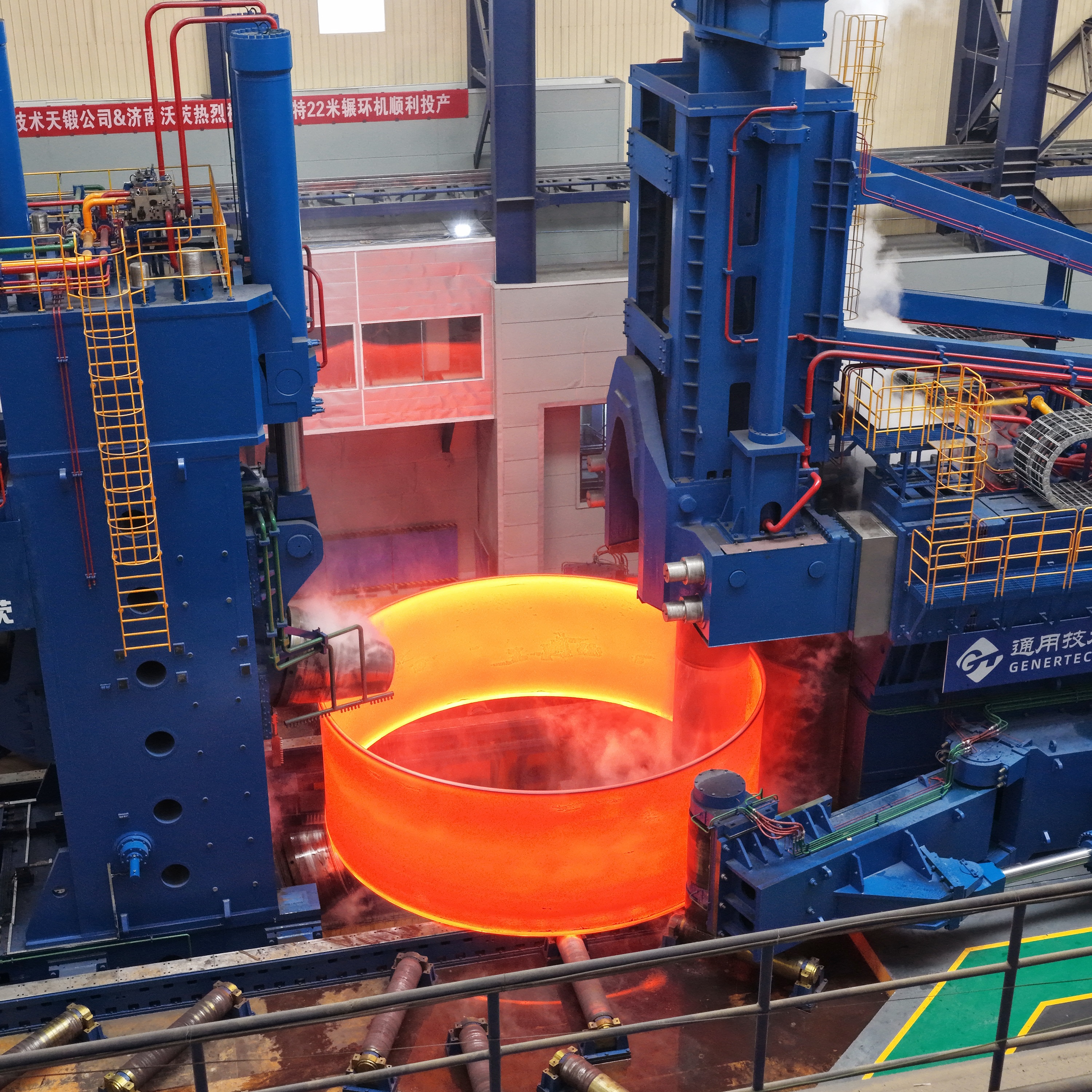
Large ring and shell rolling equipment used to produce seamless and profiling rolled rings for heavy industry.
Turkish cement rotary kiln: heat, cycling and fatigue
A core structural component for a cement rotary kiln was supplied to a cement plant in Turkey. The recorded highlights are precision forging and machining, high temperature resistance, excellent fatigue strength and extended service life, with stable operation under high-temperature and heavy-load conditions. This maps directly to the rotary-kiln parameter priorities described earlier.
Heavy-duty hydrogenation reactor: integral ring rolling at scale
For a large refinery client in a 7.5 Mt/y European refinery project, Iraeta delivered three pieces — two shell sections and one transition section — for a heavy-duty hydrogenation reactor. The recorded highlights are integral ring rolling, near-net-shape forming, superior mechanical performance and shorter production lead time, with the components designed for long service life and long-term operation.
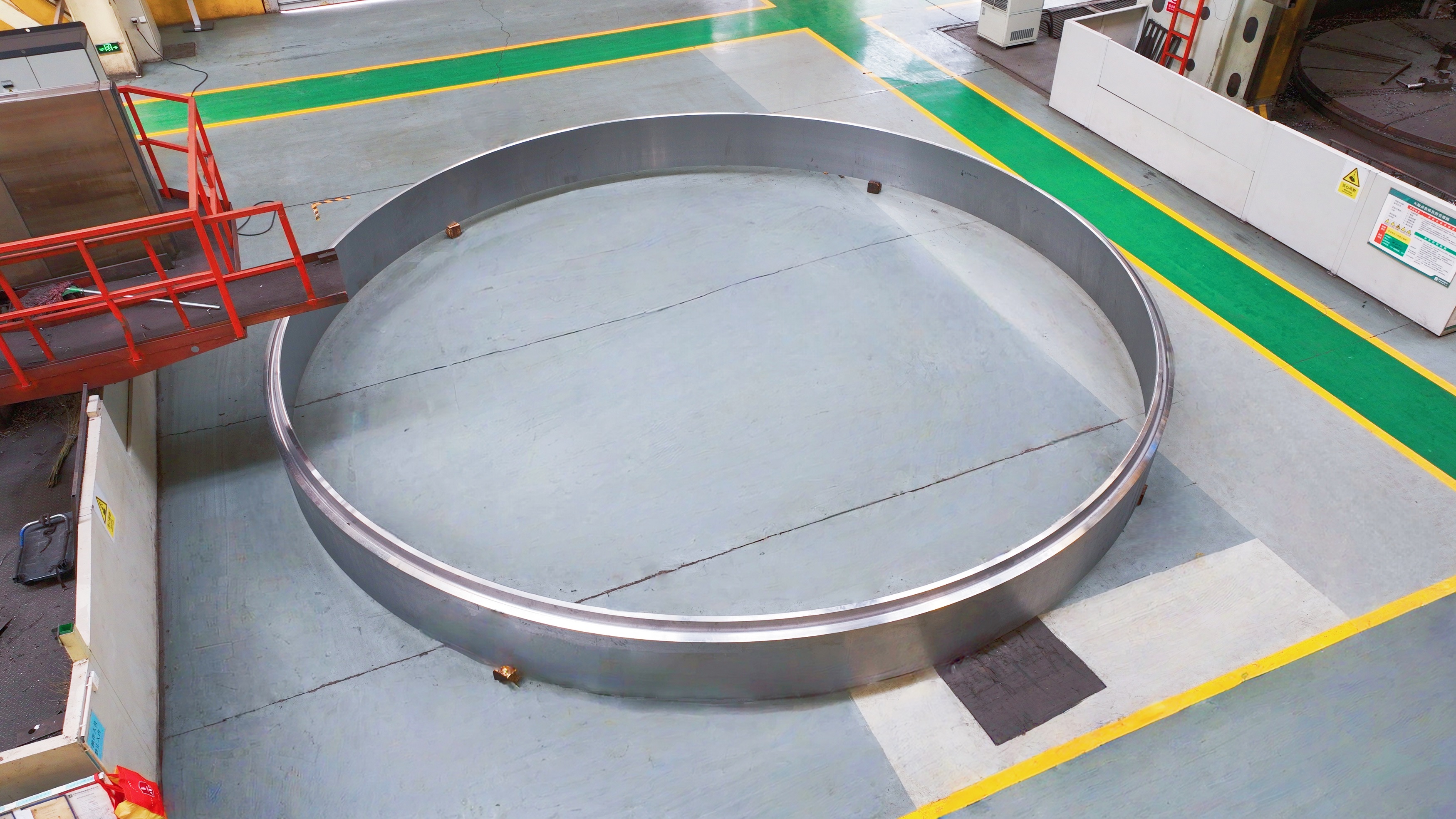
Transition section for refining equipment — a component family produced for high-temperature, high-pressure petrochemical service.
Refining and petrochemical equipment: precision and wear resistance
An oil & gas OEM in Saudi Arabia received two units of key components for refining and petrochemical equipment. Recorded highlights include high forging precision, wear resistance, high-temperature resistance and long service life, with stable operation fully compliant with the project's stringent quality and safety requirements.
European rotary kiln tyre: ultra-large diameter and thermal stability
A cement and energy equipment manufacturer in Germany received a core supporting ring / rotary kiln tyre as a single unit. Recorded highlights include ultra-large diameter integral forging, precision machining, high load-bearing capacity, excellent thermal stability and extended service life, meeting strict heavy-duty quality standards in European industrial projects.
Parameter-to-Service Comparison Table
| Service environment | Dominant degradation mechanism | Parameter priority | Verified evidence |
|---|---|---|---|
| Offshore wind | Cyclic load, salt spray, marine corrosion, low-temperature exposure | Material cleanliness, low-temperature toughness, corrosion allowance, seamless construction | Iraeta wind power flanges and gearbox forgings; components deployed in offshore engineering and wind turbines over 20 MW |
| Hydropower | High water-head pressure, long-duration fatigue | Structural integrity, circumferential property uniformity, large-diameter precision | Iraeta hydroelectric forgings; seamless rings over 21 m diameter; rolled shells up to 5 m |
| Cement rotary kiln | Extreme heat, 24/7 thermal cycling, dust corrosion, thermal expansion | Thermal stability, load-bearing capacity, fatigue strength, machining precision | Turkey kiln component (fatigue strength, high temperature resistance); Germany kiln tyre (thermal stability, ultra-large diameter integral forging); kilns at 10,000 tons/day output |
| Refining & petrochemical | High temperature, pressure, wear | Forging precision, wear resistance, high-temperature resistance | Saudi Arabia oil & gas OEM case (2 units); European 7.5 Mt/y refinery hydrogenation reactor (2 shell sections + 1 transition section) |
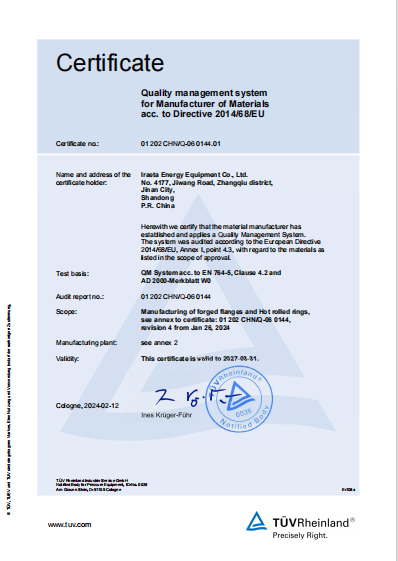
PED 2014/68/EU certificate covering manufacturing of forged flanges and hot rolled rings for the EU market.
Certification: What to Verify Before Extreme-Service Release
Two certificates are especially relevant to this topic. Iraeta holds PED 2014/68/EU (CE marking, issued by TUV, certificate number 01 202 CHN/Q-06 0144.01, valid from 2024-02-12 to 2027-03-31), covering the manufacturing of forged flanges and hot rolled rings for the EU market. The company also holds ISO 14001:2015 (certificate F01926E00118R502, issued by NQA Certification Co., Ltd. (Shanghai), valid from 2026-03-02 to 2029-03-01), covering production of raw materials for forgings, production of forgings, and production of steel balls, cylpebs and grinding rods.
In addition, the quality and structural framework includes ISO 9001:2015, ISO 45001:2018 and EN 1090. For extreme-service procurement, the practical rule is to confirm that the certificate scope names the exact product type and market you are buying for.
Frequently Asked Questions
1. Which certifications should a buyer verify for extreme-service rolled ring forgings?
At minimum, verify the certificate that matches your market and product type. Iraeta holds PED 2014/68/EU for the EU market, covering forged flanges and hot rolled rings, and ISO 14001:2015 covering raw material production for forgings, forging production, and grinding media production. The quality and safety framework also includes ISO 9001:2015, ISO 45001:2018 and EN 1090. Always check the certificate scope, number and validity dates rather than relying on a logo.
2. What is the largest and heaviest rolled ring forging Iraeta can produce?
Iraeta forges components from 0.3 kg to 300 tons. Capability includes 300-ton open-die forgings, seamless rings over 21 meters in diameter, rolled shells up to 5 meters tall, and forged bars up to 25 meters long. In 2026 the company produced a seamless rolled steel ring measuring 21.029 meters in diameter, breaking its own Guinness World Record of 15.673 meters set in 2022. Monthly capacity is 70,000 t.
3. What are the commercial terms — MOQ, delivery and payment?
The minimum order quantity is 1 unit. Delivery terms are CIF, and payment terms are 30/70. Customization covers material, size, forging shape, heat treatment and machining, so pricing depends on the specification rather than a fixed catalogue list. Because MOQ is one unit, a buyer can place a single-piece order to validate a new parameter set.
4. Can a buyer request a sample or first article before full production?
Yes in practical terms: with a minimum order quantity of 1 unit, a first-article order can function as a validation sample. Iraeta states 100% test quality control and acceptance criteria based on pre-shipment test and inspection, so the sample can be checked against the same criteria that will apply to the production batch.
5. What is the lead time for a custom extreme-service ring?
Lead time is negotiable based on the customization scope. Factors that move it include overall size and weight, material grade, heat-treatment requirements, machining tolerance and testing plan. For large integral rings used in heavy-duty projects, integral ring rolling and near-net-shape forming are recorded as contributing to shorter production lead time compared with more material-intensive routes.
Next step: turn your service conditions into a forging specification
If you are evaluating a rolled ring forging for offshore wind, hydropower, a rotary kiln or a refining application, send your operating conditions and drawing to Iraeta. Share the service environment, target material family and dimensional envelope, and the team can respond with a parameter recommendation, a sample or first-article route, and a quotation.
Email: ebiz@iraeta.com | Website: www.iraeta.com | WhatsApp: +86 18853157508
Iraeta Energy Equipment Co., Ltd. — 4177 Jiwang Road, Zhangqiu, Jinan, China. Contact: Simon Wang.
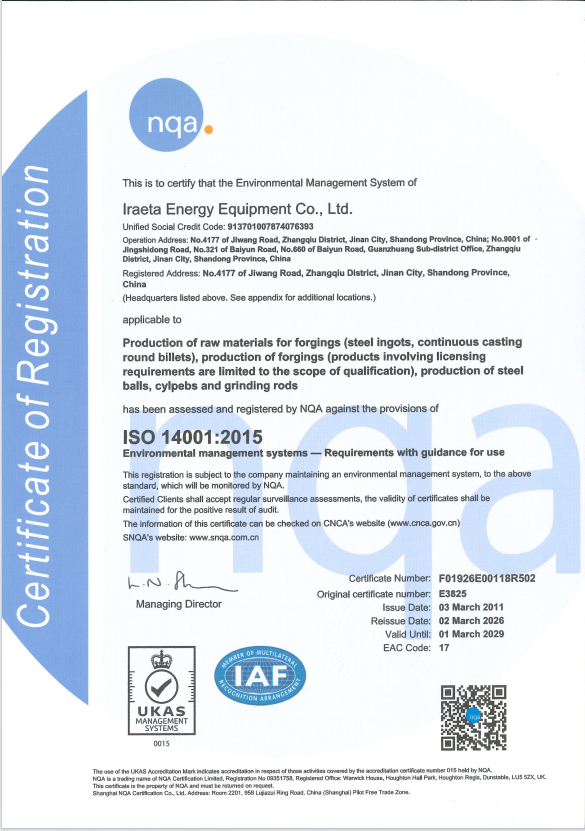
ISO 14001:2015 certificate covering forging raw material production, forging production and grinding media production.
Conclusion
Extreme-service rolled ring forgings are not selected by size alone. Offshore wind punishes fatigue, corrosion and low temperature; hydropower punishes long-duration pressure and fatigue; rotary kilns punish thermal cycling, dust and load. The correct parameter hierarchy follows directly from the environment, and it should be agreed before production rather than inspected afterward.
Iraeta's relevance here is capability-based rather than promotional: a weight range from 0.3 kg to 300 tons, 300-ton open-die forging, seamless rings over 21 meters, rolled shells up to 5 meters and forged bars up to 25 meters, integral ring rolling and near-net-shape forming, documented certification including PED 2014/68/EU and ISO 14001:2015, and delivered cases in a Turkish cement rotary kiln, a European refinery hydrogenation reactor, Saudi refining equipment and a German rotary kiln tyre.
Buyers in the evaluation-to-execution stage can use one guiding rule: define the degradation mechanism first, then let it choose the material, forming route, heat treatment, testing and certification. That sequence produces specifications that hold up in service, not just on paper.
Have Questions or Need More Details?
Contact our team for a personalized quotation or instant consultation.
Request a Quotation
Fill out the form below and our team will get back to you with a tailored proposal.
WhatsApp Direct Chat
Prefer to chat in real-time? Message us on WhatsApp for instant assistance & quick answers.
- Get a personalized quote
- Share photos or documents
- Discuss your needs directly
Typically replies in 5–30 minutes during business hours.