Selecting Seamless Rolled Rings for Shield Machine Slewing Supports: An Application Guide for TBM Projects
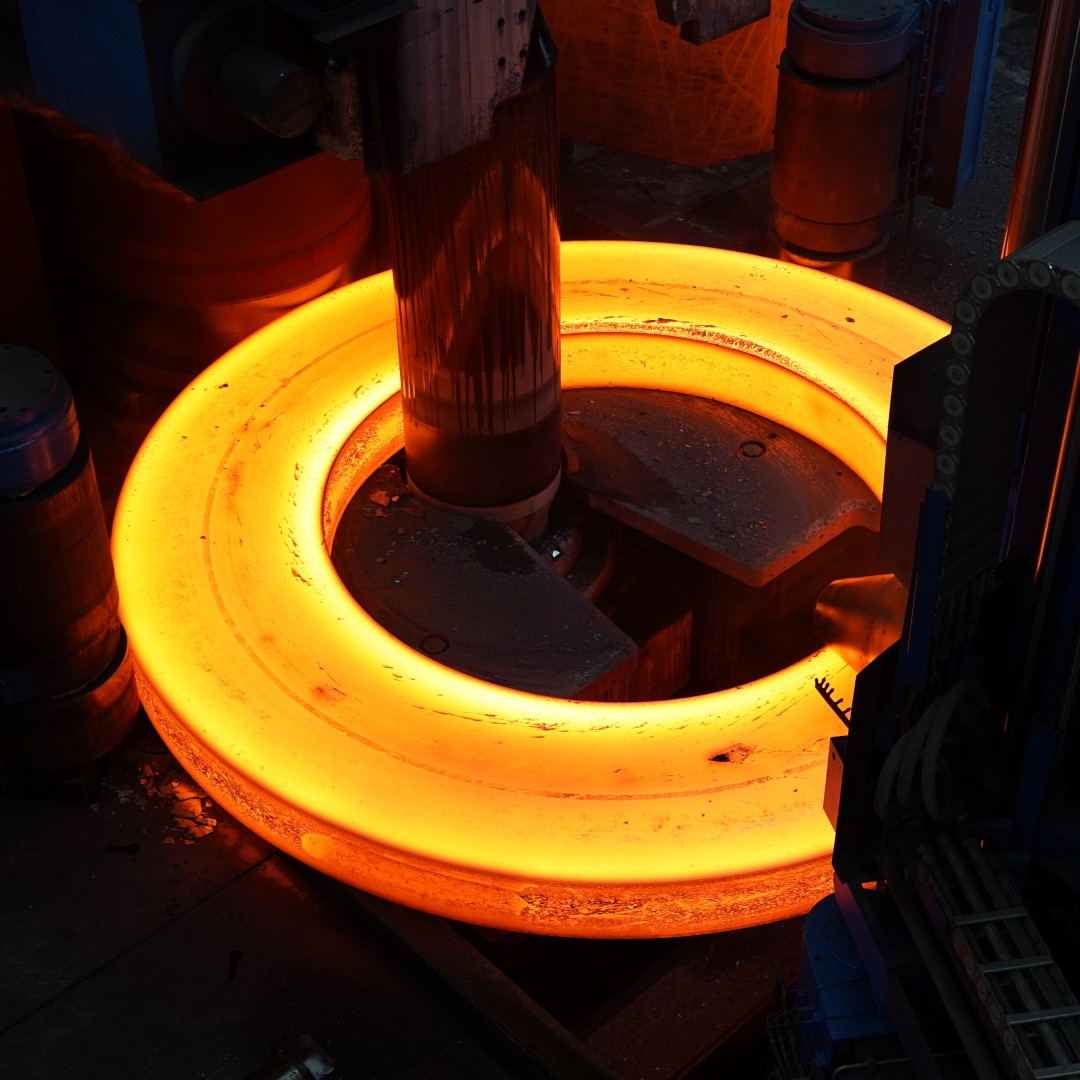
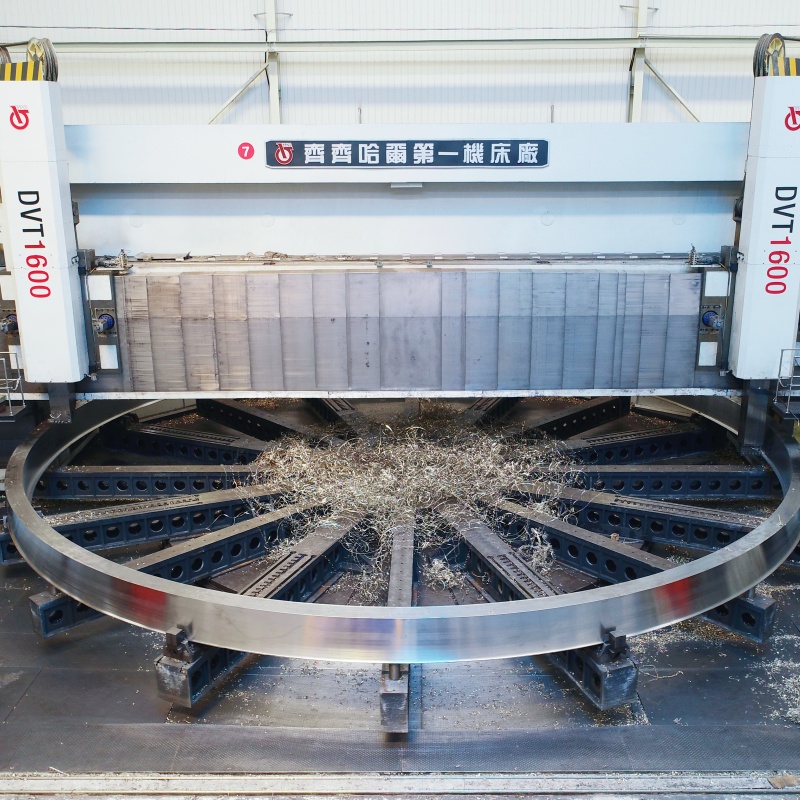
Cover: seamless rolled rings produced for tunnel boring machine applications.
A shield machine slewing support is a fatigue-critical assembly, not an accessory. It carries the rotating mass of the cutter head or shield articulation, transmits drive torque from the transmission system, and absorbs thrust, radial and tilting loads while the machine advances through mixed ground. Heavy load, vibration load, frequent start-stop with variable load, and repeated direction changes act on the same ring over a project that may run for years.
For that duty, the forming route should be decided deliberately: specify a seamless rolled ring rather than a casting or a ring cut from plate. Ring rolling works the metal circumferentially under compression and consolidates it, and controlled heat treatment then develops the fine grain structure on which fatigue resistance and impact toughness depend. A cast ring cannot offer the same assurance of internal soundness in a component whose dominant failure mode is cracking.
This guide is written for project engineers and procurement teams specifying rings for tunnel boring machine (TBM) slewing systems. It sets out what the application actually demands of the ring, how to translate those demands into a purchase specification, and which supplier capabilities should be verified before the first ring is rolled.
Iraeta Energy Equipment Co., Ltd. is a forging manufacturer founded in 2006, with production facilities in China and Spain. The company produces seamless rolled rings, shells, discs, shafts and related forged components for clean energy, tunnel boring, cement, oil and gas, marine engineering and mining, and serves markets including the EU, the USA, Japan, the Middle East, Southeast Asia, Brazil and India.
Problem Definition: What a Shield Machine Slewing Support Actually Demands
The slewing support system sits between the rotating and non-rotating structures of the machine. In this application the ring set bears load, transmits torque and maintains rotational support while the shield thrusts forward. In construction machinery, the same slewing support and transmission systems are used on shield machines and cranes, including shield machine cutter head systems and slewing mechanisms.
The working conditions are specific, and they are what separates a TBM ring from a general industrial ring:
- Load type: heavy load combined with vibration load and variable load, applied through a chain of mechanical interfaces rather than a single point.
- Operating mode: intermittent heavy-duty operation with frequent direction change and start-stop, in a high-intensity working mode.
- Environment: confined installation, soil and rock contact, dust and moisture, and shock events that vary with ground conditions.
The functional requirements follow directly from those conditions: high load capacity, impact and fatigue resistance, and wear resistance. Three failure mechanisms explain why material structure, not only dimensional accuracy, decides whether the ring survives the project.
1. Fatigue under reversing load. Every direction change reverses the stress direction in the ring at high amplitude. Because the machine works intermittently rather than rotating continuously, the ring accumulates a large number of high-stress cycles for comparatively little service time. Fatigue cracks initiate at stress raisers — surface defects, machining marks, corrosion pits, non-metallic inclusions or internal porosity — and then grow until the ring no longer supports the load.
2. Impact and shock loading. Ground conditions change within a single stroke of the cutter head, so the ring sees load peaks above its nominal steady-state load. Where the material lacks toughness, or where the structure is coarse and banded, those peaks can start cracks that fatigue then propagates.
3. Wear and fit degradation. Wear resistance matters at running and contact surfaces, while distortion or dimensional drift in mounting faces and bolt hole patterns redistributes load unevenly across the connection and accelerates every other failure mode.
The engineering consequence: a TBM slewing support ring cannot be selected on dimensions and price alone. The specification has to control how the metal was formed, how the structure was developed by heat treatment, and how the critical features were machined and verified.
Industry Background: Why Ring Supply Quality Matters More in TBM Projects
Tunnel boring machines operate in a global project market, and the construction machinery application described here is active in Germany, Japan, the United States, Korea, Australia, Brazil, the United Kingdom, France, India, Canada, Saudi Arabia and Singapore.
Ring supply is a substantial industrial segment in its own right. QY Research valued the global seamless rolled ring forgings market at USD 11,100 million in 2025, and projects it to reach USD 16,360 million by 2034. Market research covering ring rolling lists tier 1 and tier 2 suppliers as including ThyssenKrupp (Germany), Bharat Forge (India), Frisa (Mexico), Scot Forge (USA) and Iraeta (China) — a small number of plants relative to the total number of ring users.
Two structural realities matter when specifying for a TBM project.
First, the size envelope is not easily scaled. Shield tunnelling machines in the 16-meter class are in service, and machine thrust levels have grown with them. A plant cannot roll a very large ring simply by scaling up a small one: raw material preparation, the ring rolling machine, the heat treatment furnace, lifting and handling, and machining capacity all have to support the size. Iraeta's production facilities, for example, handle 300-ton open-die forgings, seamless rings above 21 meters in diameter, 5-meter-tall rolled shells and 25-meter-long forged bars — a capability profile that shapes what a project can order and how early it must be scheduled.
Second, service consequences exceed component cost by a wide margin. Replacing a slewing support ring on a TBM means stopping excavation, opening the machine and re-establishing the drive and sealing interfaces. The procurement decision is therefore dominated by the risk of unplanned stoppage rather than by the unit price of the ring. That is why fatigue resistance, structural soundness and documented verification carry so much weight in this application.
Detailed Solution: Building a Ring Specification That Survives TBM Duty
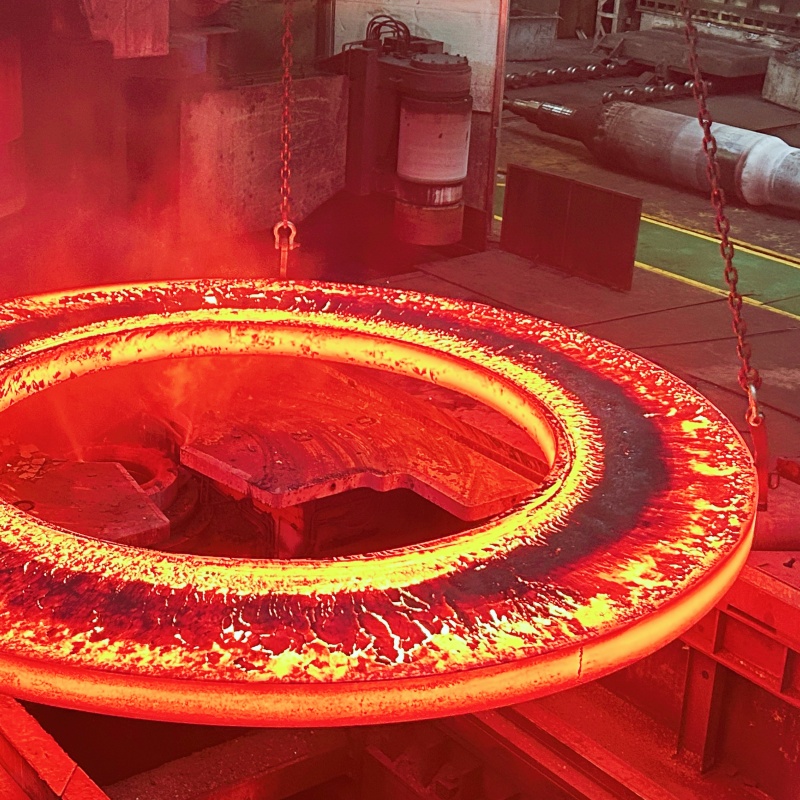
Seamless rolled rings for tunnel boring machine slewing systems.
Start from the duty cycle, not from the drawing
A TBM slewing support is not a constant-speed rotating part. Intermittent heavy-duty operation with frequent direction change means the ring accumulates high-amplitude alternating cycles quickly, and the specification should be built on that reality. Before material or geometry is fixed, the project should record:
- thrust and radial load, and the tilting moment acting on the support;
- the number of direction changes and start-stop events per working shift;
- shock or impact events expected from the ground conditions along the drive;
- the environment the ring will see, including moisture, dust and temperature range;
- the intended service interval and the consequence of unexpected replacement.
Every decision downstream — forming route, material grade, heat treatment, machining scope and inspection level — derives from this load case. Where the duty cycle is not documented, suppliers can only quote against the drawing, and the drawing rarely shows how often the ring will reverse.
Confirm the forming route: seamless rolled ring versus casting
In ring rolling, a pierced billet is deformed between a rotating main roll and a mandrel while axial rolls control height. Wall thickness reduces, diameter grows, and the metal is worked continuously around the circumference. Three consequences matter under reversing load:
- Continuous circumferential grain flow. The metal is deformed in the direction in which service stress travels, which suits a ring loaded in rotation.
- Structural consolidation by deformation. The rolled structure is formed mechanically from a wrought billet rather than solidified from a melt in a mould, so casting-type shrinkage porosity and macro-segregation are not part of the process route.
- Fine grain structure after heat treatment. Controlled rolling followed by suitable heat treatment supports a finer, more uniform structure, which is generally associated with better fatigue performance and toughness under impact than a coarse cast structure.
Cast rings are produced close to final shape and can be economical in low volumes or for non-critical positions. In slewing support duty the risk profile differs: internal porosity, inclusion clusters and coarse grain can act as initiation sites for fatigue cracks, and they cannot be removed by machining the outside of the ring. Where a casting is considered, the specification should compensate with more demanding inspection and validation — or the route should be avoided for the positions that carry the reversing load.
Match the material to load and environment
Seamless rolled rings are supplied in carbon steel, stainless steel and alloy steel, and the choice should follow the load case and the environment rather than habit:
- Alloy steel seamless rolled rings are the usual route where high strength combined with toughness is required for a load-bearing ring, and where the structure must respond predictably to heat treatment.
- Carbon steel seamless rolled rings suit positions where strength and cost drive the decision and corrosion is not a design factor.
- Stainless steel seamless rolled rings are relevant where moisture, aggressive ground water or de-icing salts are present, because corrosion pits act as stress raisers on a cyclically loaded surface.
Material selection should be made together with the forming and heat treatment route, not separately. A grade chosen for strength alone, without confirming how the finished ring will behave in fatigue, moves the risk downstream to the machine.
Specify heat treatment as a requirement, not a process name
Writing “quench and temper” on a drawing does not define the structure that reaches the machine. The purchase specification should state the mechanical properties to be achieved, the test material and location from which they will be verified, and the structural characteristics that matter for fatigue — uniformity and grain refinement rather than a process label. Because forging shape, heat treatment and machining are all variables that can be engineered, the ring route allows the structure to be developed for the duty cycle instead of accepted as-is.
High strength seamless rolled rings and precision rolled ring forgings are not defined by hardness alone. In reversing load service, the combination of strength and toughness determines how the ring behaves when a shock load arrives on top of an already cycled structure.
Control the machined features that decide fit-up and life

Precision rolled ring forgings for slewing support applications.
Life is decided at the machined features, not at the outside diameter. The specification should be explicit about:
- running and raceway surfaces, including the connection to the slewing mechanism;
- mounting face flatness and seating, since uneven seating redistributes load across the bolt group;
- bolt hole position, diameter and pattern, because position error creates local stress concentration at the most highly loaded holes;
- seal grooves and locating diameters that maintain alignment over the service interval;
- integral gear teeth or drive ring features where the design combines support and drive.
Keeping forming and finishing in one process chain reduces the risk of losing dimensional control between suppliers. Iraeta's own product range covers profiling rings, drive rings, bearing rings and precision machining, which means ring rolling, heat treatment and final machining can be planned as one sequence.
Prove the structure, not only the dimensions
Dimensional inspection confirms that the ring fits; it does not confirm that the ring will survive reversing load. A TBM ring should be released against a documented scope covering the material certificate, heat treatment records, dimensional records of the critical features, and the non-destructive testing agreed at order stage. Iraeta applies 100% testing to its supplied components, which allows the release criteria to be checked on every unit rather than on a sample drawn from the batch.
Verify the size envelope and the plant behind it
The published envelope for seamless rolled rings is a maximum height of 5 meters, a maximum diameter of 21 meters and a maximum weight of 300 tons. Most TBM slewing support rings are far smaller, but the envelope still works as a screening test: a supplier capable of rolling, heat treating, machining and measuring rings at the top of that range has the equipment and process control to handle any smaller load-bearing ring.
Iraeta's reference points in this segment include components supplied for 16-meter shield tunneling machines, and a seamless rolled steel ring of 21.029 meters in diameter produced in 2026, which exceeded the 15.673-meter record the company set in 2022. Alongside this, a reported milestone for a 15.6-meter, 150-ton ring for nuclear power illustrates how far integral ring rolling for heavy rotating equipment has developed. Monthly capacity stands at 70,000 tonnes, customization covers material, size, forging shape, heat treatment and machining, and the minimum order quantity is one unit.
Step-by-Step Breakdown: From Duty Cycle to Delivered Ring
- Document the duty specification. Record thrust, radial load, tilting moment, direction changes per shift, expected shock events and the operating environment. This document drives every later decision.
- Fix the interface envelope. Confirm outside diameter, inside diameter, section height, weight and bore before selecting a forming route, and check that the intended size sits comfortably inside a supplier's proven range.
- Select material and heat treatment condition together. Choose carbon, alloy or stainless steel against the load case and environment, then define the mechanical properties and structural requirements the heat treatment must deliver.
- Commit to the forming route in writing. State seamless rolled ring on the specification, and require the supplier to confirm the ring rolling route and the equipment that will be used.
- Define machining and inspection scope. List the critical features, tolerances, surface requirements and the non-destructive testing to be performed, then require records for each.
- Validate with a first article. Order a trial ring before series production. Because the minimum order quantity is one unit, a single validation ring can be produced, measured and sectioned or tested against the application without disrupting the project schedule.
- Review the evidence, not the promise. Compare the dimensional, material and heat treatment records against the specification, and confirm that the structure and properties meet the fatigue and impact requirements of the duty cycle.
- Lock the supply plan. Confirm production capacity for the project duration, the agreed lead time, packaging and transport, and the support arrangement after delivery, including remote after-sales support.
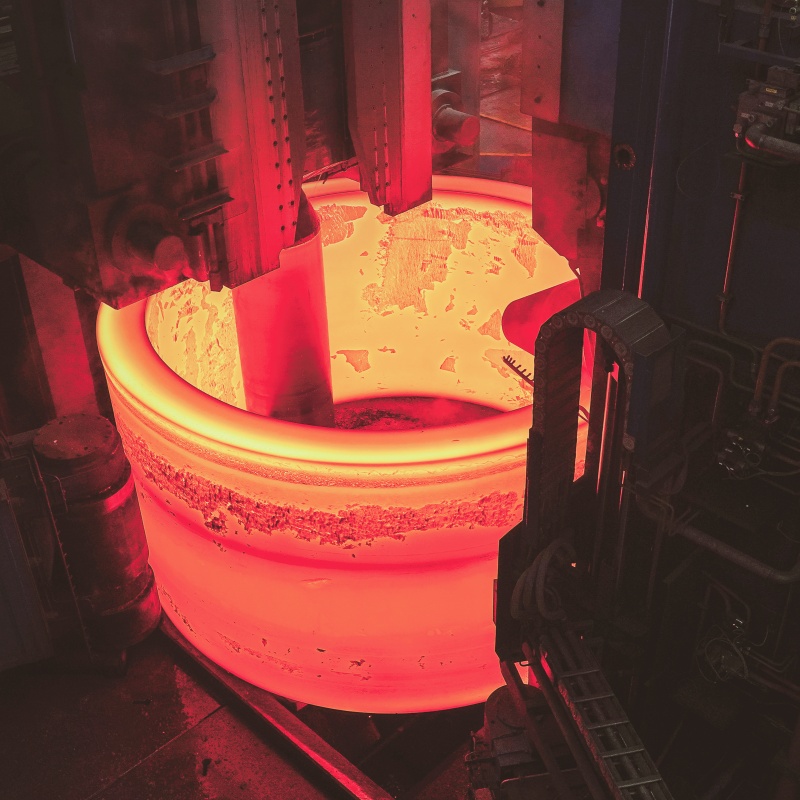
The seamless rolled rings process: circumferential deformation between main roll and mandrel.
Use Cases: Where Seamless Rolled Rings Fit in Construction Machinery
Shield machine cutter head system. The cutter head system combines rotating mass, drive torque and ground-induced shock, which is the most demanding combination in this application family. Ring position and manufacturing route should be decided together with the drive design, because the ring transmits the load path between the rotating and static structures.
Slewing mechanism and transmission system. Slewing support rings used in the slewing mechanism require the ring to maintain geometry under reversing load. Where the slewing mechanism also carries part of the drive, the ring may include machined drive features, which makes single-chain forming and machining control more valuable.
Cranes and general construction machinery. Slewing support systems in construction machinery follow the same logic: heavy load, vibration load, frequent start-stop and variable load, with impact resistance, fatigue resistance and wear resistance as the governing requirements. Specifications and supplier evaluation criteria transfer between these machines.
Adjacent heavy-duty rotating equipment. The same forming and heat treatment controls that suit TBM slewing supports are used for other continuously or cyclically loaded components. Iraeta's forged rings and related components are deployed in fourth-generation nuclear power plants, cement rotary kilns with 10,000 tons per day output, 16-meter shield tunneling machines and offshore wind turbines above 20 MW, which shows the range of duty cycles the process is expected to satisfy.
Alloy steel seamless rolled rings for high-load slewing applications.
Comparison: Forming Routes for TBM Slewing Support Rings
The table below compares the forming routes that project engineers typically consider for a slewing support ring. It is a comparison of process characteristics relevant to reversing load, not a ranking of suppliers.
| Forming route | Material integrity | Behaviour under reversing and impact load | Near-net shape at large diameters | Fit for TBM slewing support |
|---|---|---|---|---|
| Cast ring | Structure solidified in a mould; internal porosity and segregation are process risks | Coarse or non-uniform structure can act as a crack initiation site; property assurance depends heavily on additional inspection | Produced close to final shape | Generally not preferred for positions carrying the reversing load |
| Ring cut from plate or bar, then machined | Wrought material, but the ring is not deformed in the circumferential direction | Grain flow does not follow the service stress direction at the ring circumference | Requires substantial material removal and limits achievable section | Acceptable only for low-stress positions, decided case by case |
| Seamless rolled ring | Wrought billet consolidated by circumferential deformation; no casting-type porosity | Continuous circumferential grain flow and fine grain structure after heat treatment support fatigue and impact resistance | Ring rolling grows the diameter by deformation, supporting large ring sizes and profiling | Preferred route for slewing support rings |
Once the route is fixed, the specification should be organized around the requirements that actually govern life. The checklist below groups them for review before a purchase order is issued.
| Requirement area | What to state in the specification | Why it matters for the slewing support |
|---|---|---|
| Duty cycle | Loads, tilting moment, direction changes per shift, shock events | Sets the fatigue and impact basis for material and heat treatment |
| Forming route | Seamless rolled ring, with the rolling route confirmed by the supplier | Determines grain flow, structural density and the fatigue starting point |
| Material | Carbon steel, alloy steel or stainless steel, with the environment stated | Balances strength, toughness and corrosion behaviour for the site |
| Heat treatment | Mechanical properties and structural requirements to be verified, with test location | Develops the fine grain structure the fatigue performance depends on |
| Machining | Running surfaces, mounting face flatness, bolt pattern, seal grooves, drive features | Controls load distribution between the ring and the machine structure |
| Verification | Dimensional records, material certificates, heat treatment records, agreed non-destructive testing | Provides evidence that the ring meets the specification before fitment |
| Supply envelope | Required size and weight against the supplier's proven capability | Confirms the ring can be rolled, heat treated and machined as designed |
FAQ: Selecting Seamless Rolled Rings for TBM Projects
Which standards and documentation should we ask for on a TBM slewing ring?
The standards that apply depend on the market and the end use rather than on the component name. For the EU market, pressure equipment requires PED 2014/68/EU certification and structural components fall under EN 1090; suppliers serving the aerospace sector are held to the AS9100 quality management system standard. For a TBM slewing ring, the useful request is a defined document set: material certificate for the grade supplied, heat treatment record, dimensional record for the critical machined features, and the non-destructive testing agreed in the purchase order. Iraeta supplies rings in carbon steel, stainless steel and alloy steel with 100% testing applied to supplied components, which allows the agreed release criteria to be checked on each unit.
Can the supplier actually produce rings in the size our TBM project needs?
The relevant capability envelope for seamless rolled rings is a maximum height of 5 meters, a maximum diameter of 21 meters and a maximum weight of 300 tons. TBM slewing support rings normally sit well inside that envelope, and the envelope matters because it indicates the plant's rolling, heat treatment, handling and machining range. Iraeta's ring rolling equipment is 22-meter class, and its components are in service on 16-meter shield tunneling machines; the company produced a seamless rolled steel ring of 21.029 meters in diameter in 2026, exceeding its own 15.673-meter ring from 2022. Monthly capacity is 70,000 tonnes with a minimum order quantity of one unit.
What drives the cost of a seamless rolled ring for a slewing support?
Cost follows the specification rather than the catalogue. The main drivers are the material grade and the finished weight of the ring, the forming route and the amount of material that must be removed to reach the machined shape, the heat treatment condition, the extent of machining on running surfaces and bolt patterns, the inspection and testing scope, and the quantity ordered against the production schedule. Urgency is a further factor, since scheduling a large ring around existing capacity affects delivery. Because the minimum order quantity is one unit, a single trial ring can be produced and validated before a project-scale order is placed. Lead time is negotiable based on the customization required.
Can we validate a sample or first-article ring before committing to the project order?
Yes — validation before serial supply is the practical way to reduce fatigue risk, because the properties that matter most, such as structure and toughness, cannot be confirmed from a drawing. A first-article ring can be produced as a single unit, measured against the critical features, and released with its material, heat treatment and inspection records for review by the project engineering team. Customization covers material, size, forging shape, heat treatment and machining, so the trial ring can represent the intended production configuration rather than an approximation of it.
What lead time and after-delivery support should we plan for?
Lead time for a seamless rolled ring is quoted as negotiable based on the customization required, because size, material grade, heat treatment and machining scope all change the production sequence. Project teams should therefore plan the ring order around the supplier's capacity — 70,000 tonnes per month at Iraeta — and confirm the schedule at order stage rather than assuming a fixed number of weeks. After-delivery support is provided remotely, which covers the technical questions that arise during fitment and operation. If you are preparing a TBM slewing support specification, Iraeta can review the duty cycle and drawing and confirm feasibility within the 21-meter diameter, 5-meter height and 300-ton weight envelope: contact Simon Wang at ebiz@iraeta.com or +86 188-5315-7508, or visit www.iraeta.com.
Conclusion: Specifying the Ring That Lasts the Drive
Shield machine slewing supports fail in ways that dimensions cannot predict. Intermittent heavy-duty operation, frequent direction changes and impact loading in a high-load environment push the ring into a fatigue regime where structure matters more than geometry. The practical conclusion for TBM projects is straightforward: select the forming route deliberately, specify a seamless rolled ring, define material and heat treatment against the documented duty cycle, and require evidence that the delivered ring meets that specification.
Ring rolling gives the ring continuous circumferential grain flow and a consolidated wrought structure, and controlled heat treatment develops the fine grain structure that supports fatigue and impact resistance — the same characteristics that make cast rings risky in this position. Capability then has to be verified: the size envelope, the equipment behind it, the inspection scope, and the ability to produce and validate a first article before the project depends on the result.
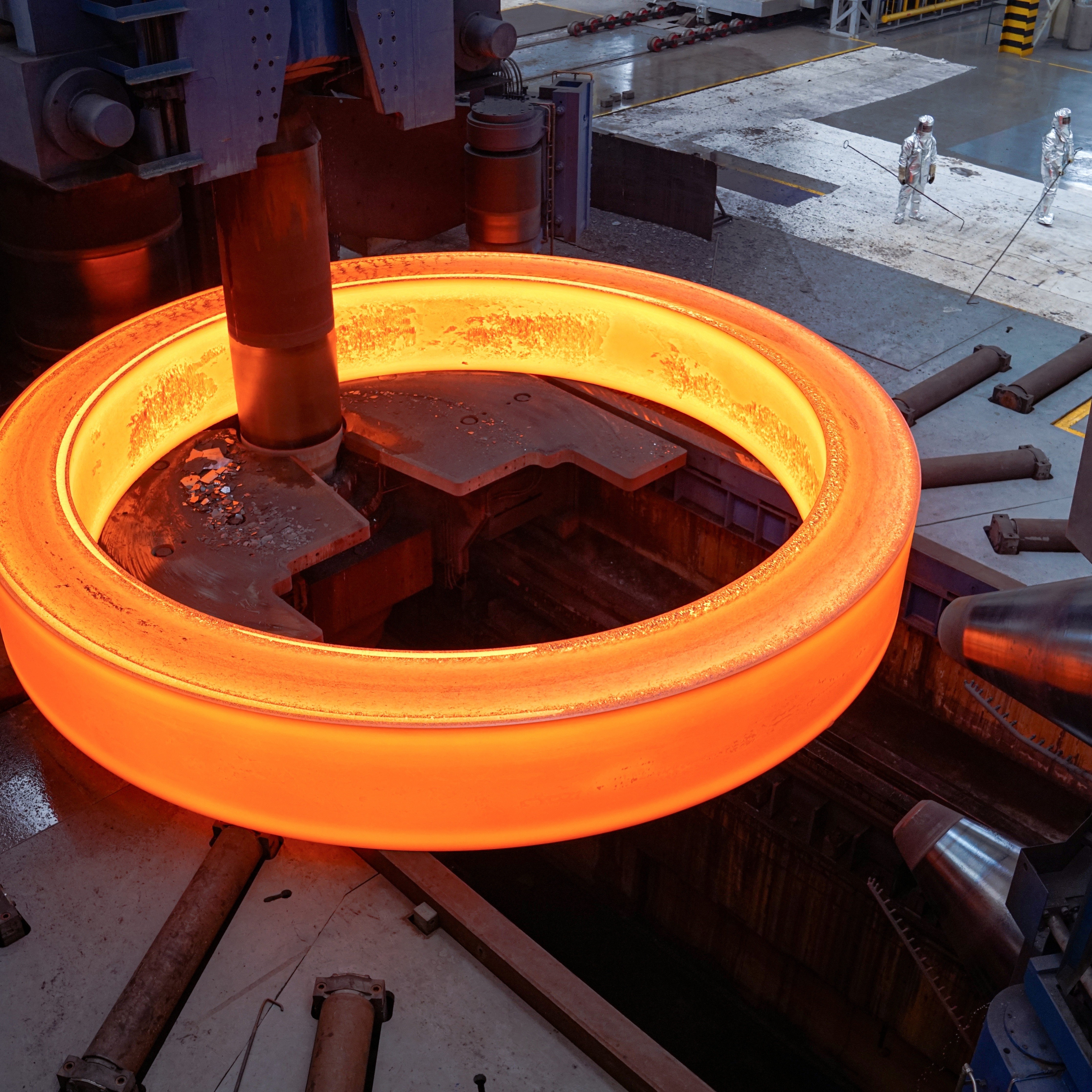
Large seamless rolled rings produced for heavy-duty slewing and support applications.
Next step: send your TBM slewing support drawing and duty cycle to Iraeta for a feasibility review and a sample or quotation request. Contact Simon Wang — ebiz@iraeta.com — Tel / WhatsApp +86 188-5315-7508 — 4177 Jiwang Road, Zhangqiu, Jinan, China — www.iraeta.com.
Have Questions or Need More Details?
Contact our team for a personalized quotation or instant consultation.
Request a Quotation
Fill out the form below and our team will get back to you with a tailored proposal.
WhatsApp Direct Chat
Prefer to chat in real-time? Message us on WhatsApp for instant assistance & quick answers.
- Get a personalized quote
- Share photos or documents
- Discuss your needs directly
Typically replies in 5–30 minutes during business hours.