Seamless Rolled Rings for Shield Machine and Crane Drive Systems: A Technical Selection Guide
Quick answer: Seamless rolled rings for shield machine cutterhead, slewing and transmission systems and for crane transmission and slewing support systems are specified on four parameters — load capacity, impact and fatigue resistance, wear resistance, and dimensional and material consistency under intermittent heavy-duty duty cycles. Because these rings operate under heavy load, vibration load and frequent start-stop with variable load, the specification has to be locked against the duty cycle first and against supplier capability second. The parameters that must be frozen before an RFQ is released are outside diameter, height, net weight, material grade, heat treatment condition, testing coverage and pre-shipment acceptance criteria. Iraeta manufactures seamless rolled rings from 0.3 kg to 300 tons, with a maximum diameter of 21 meters and a maximum height of 5 meters.
Specification arguments in construction machinery rarely fail because someone picked the wrong ring shape. They fail because the ring was selected against a static load case while the machine actually runs an intermittent heavy-duty duty cycle with frequent direction changes, and the ring had already been bought before anyone wrote down the fatigue, impact and wear requirements.
This guide is written for the engineers and technical buyers who have to sign off on those rings. It covers what a shield machine and crane drive system demands from a ring, why the forging route determines whether those demands can be met at all, which dimensional and material limits bound the design, and how to convert all of that into acceptance criteria that a supplier can be measured against.
Problem Definition: The Duty Cycle Is the Real Constraint
The construction machinery industry — covering markets such as Germany, Japan, the United States, South Korea, Australia, Brazil, the United Kingdom, France, India, Canada, Saudi Arabia and Singapore — imposes a working condition on rings that is unlike almost any other industrial application. The load is heavy. The load is also vibratory. And the machine does not run at steady state: it starts, stops, reverses and accelerates under load, thousands of times over its service life.
In shield machine and crane applications specifically, the ring's defined function is load bearing, torque transmission and slewing support. The matched equipment is the shield machine itself, the shield machine cutter head system, the slewing mechanism, the transmission system and the crane. The operation mode is intermittent heavy-duty operation with frequent direction change and start-stop — a high-intensity working mode in which the ring is repeatedly loaded, unloaded and loaded again in the opposite direction.
That duty cycle generates three distinct failure pathways, and each one has a different specification answer:
- Overload and plastic deformation. Addressed through material strength and section geometry, which in turn are bounded by the achievable ring diameter, height and weight.
- Impact and fatigue cracking. Addressed through internal soundness, grain structure and toughness — properties determined primarily by how the ring was formed, not by how it was machined.
- Wear and surface degradation. Addressed through material grade, hardness and the condition of the running surfaces.
The practical problem is that a ring can pass dimensional inspection and still fail all three. Dimensional conformity is a manufacturing check; internal soundness is a metallurgical outcome. If a purchasing specification only captures the first, the second is left to chance.
Industry Background: Scale, Demand and Supply Base
Seamless rolled rings are not a niche forging category. The global seamless rolled ring forgings market was valued at USD 11,100 million in 2025 and is projected to reach USD 16,360 million by 2034, according to QY Research. Within that total, one of the clearest growth signals sits in an adjacent heavy-duty application: the wind turbine forged tower flange market is expected to grow at a CAGR of 7.3% to reach USD 8.2 billion by 2033, per Dataintelo.
The supply base is concentrated. Tier 1 and tier 2 suppliers identified in the ring rolling market include ThyssenKrupp (Germany), Bharat Forge (India), Frisa (Mexico), Scot Forge (USA) and Iraeta (China). Chinese seamless rolled ring suppliers are reported to command over 40% of global output as of 2026. For a buyer specifying rings for shield machines or cranes, that concentration has a direct consequence: the number of suppliers capable of producing very large, internally sound rings under a controlled material route is small, and capability verification matters as much as price comparison.
Iraeta Energy Equipment Co., Ltd. is a forging specialist founded in 2006, producing discs, rings, shells, bars, shafts and wear-resistant grinding media across a 0.3 kg to 300 ton range, with production facilities in China and Spain serving clean energy, oil and gas, marine engineering, tunnel boring, cement production and metal mining. Its extreme manufacturing capabilities include 300-ton open-die forgings, over 21-meter seamless rings, 5-meter-tall rolled shells and 25-meter-long forged bars — capabilities held by only a few companies worldwide.
Detailed Solution: What Actually Determines Ring Performance
Why the forging route, not the drawing, decides fatigue life
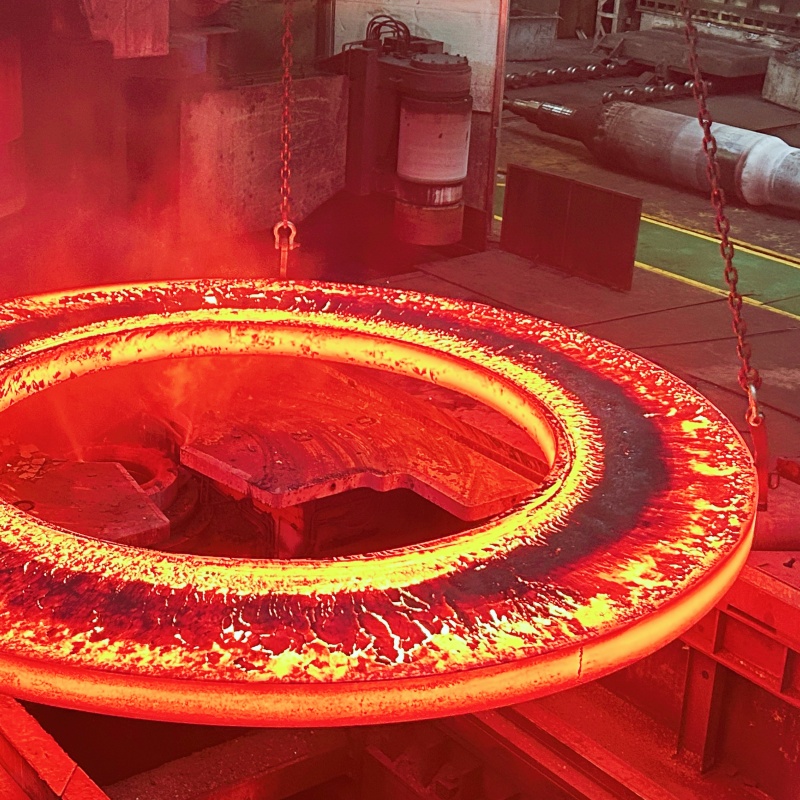
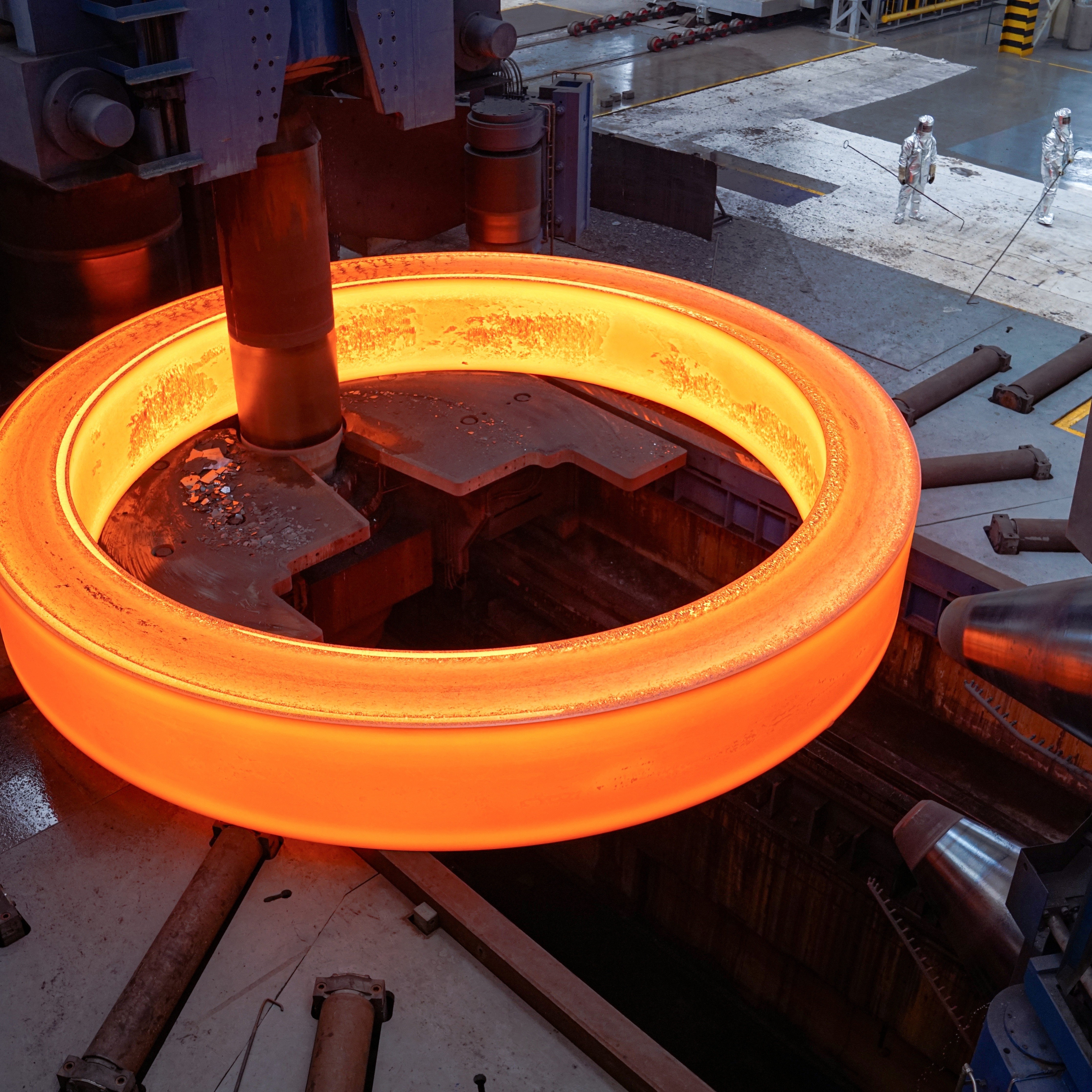
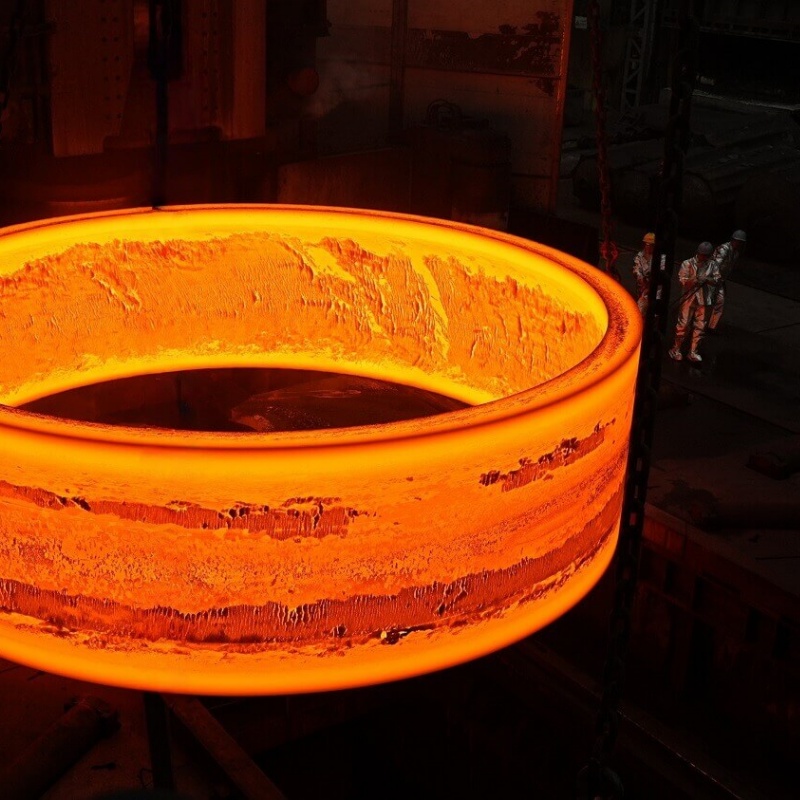
A seamless rolled ring starts as a pierced and upset billet that is expanded between a main roll and an axial roll until the wall thickness and diameter are reached. The metal is worked continuously around the circumference, so the grain flow follows the ring's contour rather than being cut across by machining from plate or bar stock.
Compared with a cast component, this matters for reasons that show up directly in the shield machine and crane duty cycle. Casting can leave internal porosity, shrinkage voids and segregation in the section. Those discontinuities act as stress raisers, and under intermittent heavy-duty operation with frequent direction changes they become crack initiation sites. Forging consolidates the material and eliminates that porosity, and the deformation that produces the ring also refines the grain structure. The practical outcomes are higher strength and toughness, and better fatigue resistance — which is precisely the property set the application demands.
Material selection: matching grade to the wear and corrosion environment
Seamless rolled rings are available in carbon steel, stainless steel and alloy steel. The selection logic is not cosmetic:
- Carbon steel is the baseline for rings where load capacity and cost efficiency drive the decision and the environment is controlled.
- Alloy steel is selected where higher strength and toughness are needed in the section, which is typical for high-strength rings on crane slewing and transmission positions.
- Stainless steel is selected where corrosion resistance is required — for example in coastal, humid or wash-down environments where surface degradation would compromise the ring's function.
Because material grade, heat treatment and forging shape can all be customized, the correct sequence is to define the duty cycle first, then derive the material and heat-treatment condition from it — not to fix a grade before the load case is understood.
Dimensional and weight limits bound the design envelope
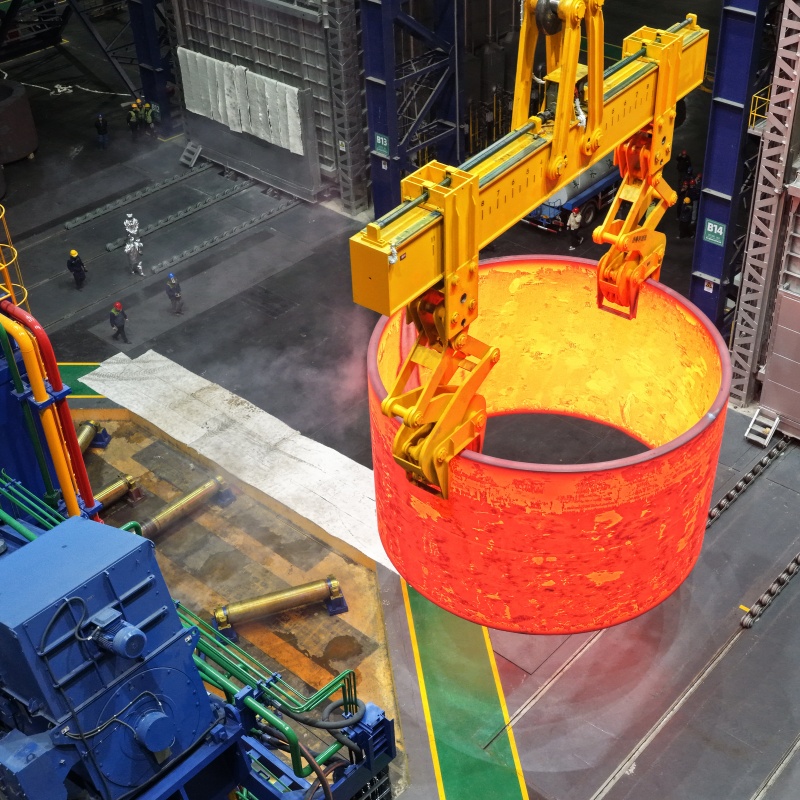
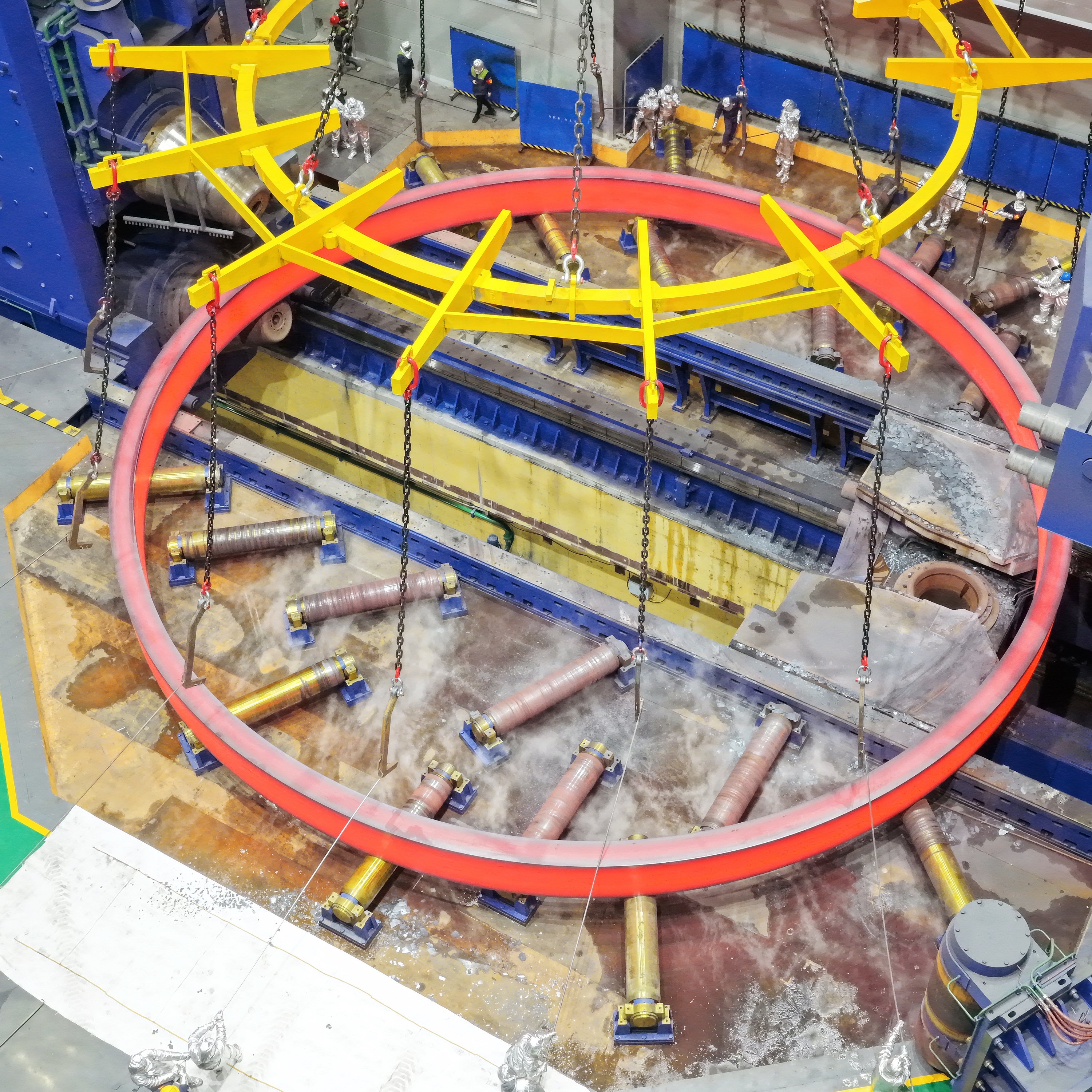
Design intent is only useful if it can be produced. The production envelope for seamless rolled rings is a maximum height of 5 meters, a maximum diameter of 21 meters and a maximum net weight of 300 tons, with the overall range extending down to 0.3 kg. In 2026, Iraeta manufactured a seamless rolled steel ring measuring 21.029 meters in diameter, breaking its own Guinness World Record of 15.673 meters set in 2022. The rolling equipment behind this includes a 22-meter ring and shell rolling machine.
The engineering consequence is straightforward: a shield machine slewing or cutterhead ring that appears oversized against conventional forging limits may still fall inside the producible envelope, and the rolling machine capacity — not the ring drawing — is what determines the upper bound.
Material consistency starts upstream of the forge
Two rings forged to the same drawing can behave differently if the input steel differs in chemistry or cleanliness. That is the argument for an in-house steel mill: when the steel ingot and continuous casting round billet are produced under the same quality system as the forging itself, chemistry and cleanliness are controlled at the source rather than accepted on a supplier certificate.
A 100-engineer R&D team supports customized material formulation, which is what allows a ring's material to be tuned to a specific shield machine or crane duty cycle instead of being selected from a fixed catalogue of grades. Where a project requires a chemistry window that sits outside standard specifications, formulation is where that requirement is met.
Compliance: what a ring has to carry into an EU or global project
For pressure-related and structural applications in the EU market, certification is a hard constraint rather than a preference. Seamless rolled rings for the EU market require PED 2014/68/EU certification for pressure equipment and EN 1090 for structural components. Iraeta holds both:
- PED 2014/68/EU — issued by TUV, certificate number 01 202 CHN/Q-06 0144.01, EU market, covering the manufacturing of forged flanges and hot rolled rings.
- EN 1090-1:2009+A1:2011 and EN 1090-2 — issued by TUV, certificate number 0035-CPR-1090-1.03389.TÜVRh.2025.003, covering structural components and kits for steel structures to EXC3 for load-bearing structures in all types of buildings in the EU market.
- ISO 9001:2015 — issued by BV, certificate number F02326Q00125R602, global market, covering the manufacturing of raw materials for forgings (steel ingot and continuous casting round billet), manufacturing of forgings, and manufacturing of steel balls, cylpebs and grinding rods.
- ISO 14001:2015 — issued by NQA Certification Co., Ltd. (Shanghai), certificate number F01926E00118R502, global market.
- ISO 45001:2018 — issued by SQA Certification Co., Ltd. (Shanghai), certificate number F01926800070R502, global market.
Note: aerospace-grade sub-supply chains are a separate compliance universe and require AS9100; it is not a substitute for, or an equivalent of, the EU requirements above.
Inspection coverage defines the acceptance boundary
Quality control on Iraeta seamless rolled rings is 100% test, with full-item inspection applied to incoming and finished items, and pre-shipment inspection available as an agreed acceptance gate. For a buyer, the operative question is not whether the supplier tests, but which characteristics are tested on which items, and what documentation travels with the shipment.
Step-by-Step Breakdown: Specifying a Shield Machine or Crane Ring
- Define the duty cycle in writing. State that the ring operates under intermittent heavy-duty conditions with frequent direction change and start-stop, and specify whether the dominant mode is load bearing, torque transmission or slewing support. This single sentence determines everything downstream.
- Convert the duty cycle into load cases. Establish the static load, the vibratory component and the number of load reversals expected over service life. Ring geometry and section thickness follow from these three inputs, not from a preferred diameter.
- Check the geometry against the production envelope. Compare required outside diameter, height and net weight against a 21-meter maximum diameter, 5-meter maximum height and 300-ton maximum net weight. If the design sits near a limit, confirm rolling machine capacity before releasing the drawing.
- Select material and heat treatment together. Choose carbon steel, stainless steel or alloy steel against the load, wear and corrosion requirements, then specify the heat-treatment condition. Where standard grades cannot satisfy the load or corrosion case, request a customized material formulation.
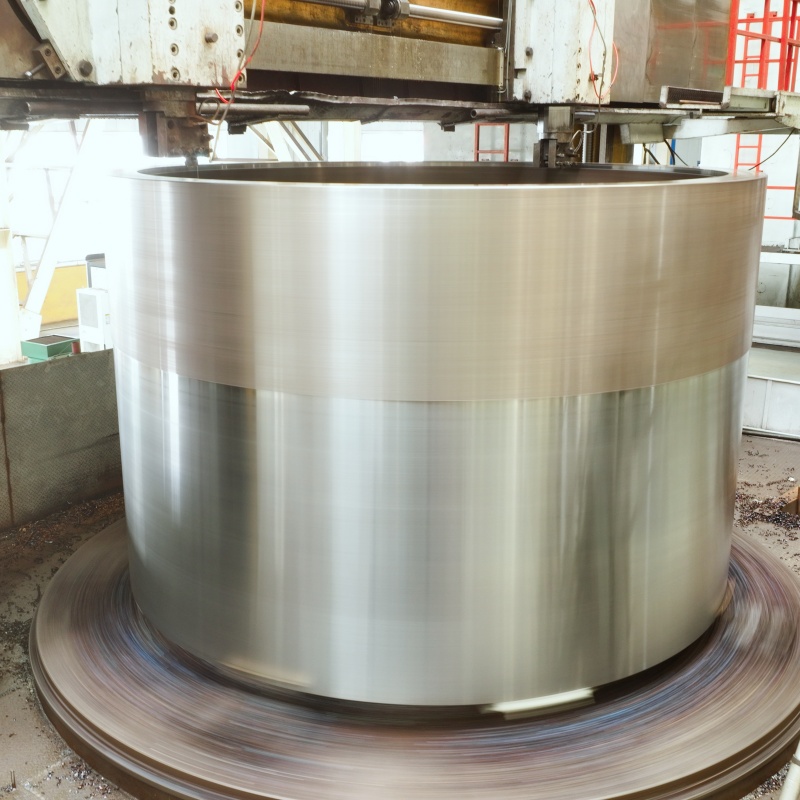
- Fix the forming route. Specify a seamless rolled ring forging rather than a casting or a machined-from-plate component. This is the step that determines internal soundness, grain refinement and fatigue resistance, and it cannot be recovered later by machining.
- Agree the inspection and acceptance criteria. Define the dimensional tolerances, the material verification method, the testing coverage and whether pre-shipment inspection is required. Confirm that testing is 100% test rather than sampling, and agree the documentation package.
- Qualify the supplier against compliance and capacity. Verify the certifications that the destination market requires — PED 2014/68/EU and EN 1090 for EU structural and pressure applications, ISO 9001:2015, ISO 14001:2015 and ISO 45001:2018 as the global baseline — and verify monthly capacity of 70,000 t against the project schedule.
Use Cases: Where These Rings Actually Sit
Shield machine cutterhead and slewing systems
In a shield machine, the ring sits in the cutter head system, the slewing mechanism and the transmission system. It carries load, transmits torque and provides the slewing support that lets the cutting structure rotate and reposition under thrust. The loading is not a smooth torque curve: the ring sees vibration load and variable load as the face conditions change, and it does so in an intermittent heavy-duty pattern with frequent direction change. The requirements that follow are high load capacity, impact and fatigue resistance, and wear resistance on the loaded surfaces. Iraeta's seamless rolled rings are used in applications that include 16-meter shield tunneling machines.
Crane transmission and slewing support
In crane transmission and slewing support positions, the ring is the interface between the rotating superstructure and the load path. Its function is again load bearing, torque transmission and slewing support, but the duty cycle adds start-stop and direction reversal under a suspended load, which produces repeated impact rather than steady stress. Fatigue resistance and internal soundness dominate the selection; a casting porosity defect at this location is a service-life problem, not a dimensional one.
Adjacent heavy-duty drive systems
The same parameter logic transfers to other intermittent heavy-duty drive positions. Where the failure consequence is high and the duty cycle is severe, the ring selection procedure does not change — only the material grade and the environmental requirements do.
Comparison Table
The same ring, specified for two different machines, is weighted differently across parameters. The table below maps the shared parameters to the emphasis each application places on them, and to what the buyer should verify in the RFQ.
| Parameter | Shield machine (cutterhead, slewing, transmission) | Crane (transmission, slewing support) | What to verify in the RFQ |
|---|---|---|---|
| Load capacity | High — combined thrust, torque and vibration load | High — suspended load plus dynamic amplification | Section geometry against the max 21 m diameter / 5 m height / 300 t weight envelope |
| Impact resistance | Critical — variable load as face conditions change | Critical — start-stop and reversal under load | Forged seamless route, material grade and heat treatment condition |
| Fatigue resistance | Critical — intermittent heavy-duty operation with frequent direction change | Critical — repeated load reversal per duty cycle | Internal soundness, grain refinement, absence of casting porosity |
| Wear resistance | High on loaded and sliding surfaces | Moderate to high on slewing contact surfaces | Material grade and surface condition |
| Material consistency | High — chemistry and cleanliness affect fatigue life | High — batch-to-batch variation affects interchangeability | In-house steel source and customized material formulation |
| Compliance | Market-dependent (EU projects: PED 2014/68/EU, EN 1090) | Market-dependent (EU projects: PED 2014/68/EU, EN 1090) | Certificate numbers, market scope and validity |
| Acceptance | Dimensional plus metallurgical | Dimensional plus metallurgical | 100% test coverage and pre-shipment inspection agreement |
The next table fixes the producible and certifiable envelope that a specification has to fit inside. All values below are Iraeta capability and compliance facts, not generic industry averages.
| Specification item | Value |
|---|---|
| Product type | Seamless rolled ring forgings |
| Weight range | 0.3 kg to 300 tons |
| Maximum diameter | 21 meters |
| Maximum height | 5 meters |
| Maximum net weight | 300 tons |
| Materials | Carbon steel, stainless steel, alloy steel |
| Customization scope | Material, size, forging shape, heat treatment, machining |
| Monthly capacity | 70,000 t |
| Minimum order quantity | 1 unit |
| Quality control | 100% test, full-item inspection |
| Lead time | Negotiable based on customization |
| After-sales | Remote support |
| Export markets | EU, Americas, Asia, Middle East |
| Certification — EU | PED 2014/68/EU (TUV, 01 202 CHN/Q-06 0144.01); EN 1090-1:2009+A1:2011 and EN 1090-2 (TUV, 0035-CPR-1090-1.03389.TÜVRh.2025.003) |
| Certification — global | ISO 9001:2015 (BV, F02326Q00125R602); ISO 14001:2015 (NQA Shanghai, F01926E00118R502); ISO 45001:2018 (SQA Shanghai, F01926800070R502) |
FAQ
1. Which certifications do seamless rolled rings need for shield machine and crane projects in the EU?
Pressure-related and structural ring applications in the EU market require PED 2014/68/EU and EN 1090 respectively. Iraeta holds PED 2014/68/EU, issued by TUV under certificate number 01 202 CHN/Q-06 0144.01, covering the manufacturing of forged flanges and hot rolled rings. It also holds EN 1090-1:2009+A1:2011 and EN 1090-2, issued by TUV under certificate number 0035-CPR-1090-1.03389.TÜVRh.2025.003, covering structural components and kits for steel structures to EXC3 for load-bearing structures in all types of buildings in the EU market. ISO 9001:2015 (BV, F02326Q00125R602), ISO 14001:2015 (NQA Shanghai, F01926E00118R502) and ISO 45001:2018 (SQA Shanghai, F01926800070R502) apply globally.
2. What is the largest seamless rolled ring available for these drive systems?
For seamless rolled rings, the maximum diameter is 21 meters, the maximum height is 5 meters and the maximum net weight is 300 tons, with the product weight range starting at 0.3 kg. In 2026, Iraeta manufactured a seamless rolled steel ring measuring 21.029 meters in diameter, breaking its own Guinness World Record of 15.673 meters set in 2022. The rolling equipment includes a 22-meter ring and shell rolling machine, and a 100-engineer R&D team supports customized material formulation where standard grades are insufficient.
3. What are the commercial constraints — MOQ, lead time and capacity?
The minimum order quantity for seamless rolled rings is 1 unit, which means a project can place a single ring without committing to a series. Monthly capacity is 70,000 t, which is normally the binding constraint on large multi-ring schedules rather than per-unit production rate. Lead time is negotiable based on customization: the wider the customized scope across material, size, forging shape, heat treatment and machining, the more of the schedule is driven by material preparation and heat treatment rather than by rolling itself.
4. Can a single ring be supplied for validation before series production?
Yes. With a minimum order quantity of 1 unit and 100% test quality control, a project can order one ring, run it through its own validation — dimensional check, material verification and, where required, pre-shipment inspection — and only then release a series order. This is the practical route for confirming that a forging-based ring performs under the real intermittent heavy-duty duty cycle before the full quantity is committed.
5. How should pre-shipment inspection be agreed?
Pre-shipment inspection should be written into the order as an acceptance gate covering dimensional tolerances, material verification and testing coverage, supported by the documentation package that ships with the rings. Because Iraeta applies 100% test and full-item inspection, the inspection agreement defines scope and documentation rather than negotiating the existence of testing. Alternatively, providing the ring diameter, height, net weight, material and duty cycle is enough for Iraeta to confirm producibility against the 21-meter diameter, 5-meter height and 300-ton envelope and to issue a quotation — the contact point for that is ebiz@iraeta.com or www.iraeta.com.
Conclusion
For shield machine and crane drive systems, the ring specification is decided by the duty cycle, not by the catalogue. Intermittent heavy-duty operation with frequent direction change and start-stop means the ring has to resist load, impact, fatigue and wear simultaneously — and of those four, fatigue resistance is the one that a dimensional inspection certificate cannot prove. It is a metallurgical outcome, produced by consolidating the material through seamless rolling and refining the grain structure in the process.
The practical sequence for a technical buyer is therefore: write the duty cycle down, convert it into load cases, check the geometry against the 21-meter diameter, 5-meter height and 300-ton envelope, select material and heat treatment together, lock the forged seamless route, agree the inspection and acceptance criteria, and only then compare suppliers on certification and capacity. Doing it in that order keeps the constraint where it belongs — on the ring's service behaviour — instead of on a tolerance table that says nothing about whether the ring will survive ten thousand load reversals.
Next step
Send the ring diameter, height, net weight, material and the duty cycle of your shield machine or crane application. Iraeta will confirm producibility against its 21-meter diameter, 5-meter height and 300-ton forging envelope and return a quotation. Single-unit orders are accepted.
Email: ebiz@iraeta.com | Web: www.iraeta.com | WhatsApp: +86 18853157508
Have Questions or Need More Details?
Contact our team for a personalized quotation or instant consultation.
Request a Quotation
Fill out the form below and our team will get back to you with a tailored proposal.
WhatsApp Direct Chat
Prefer to chat in real-time? Message us on WhatsApp for instant assistance & quick answers.
- Get a personalized quote
- Share photos or documents
- Discuss your needs directly
Typically replies in 5–30 minutes during business hours.