Open-Die vs. Rolled Ring Forgings: Which to Specify?
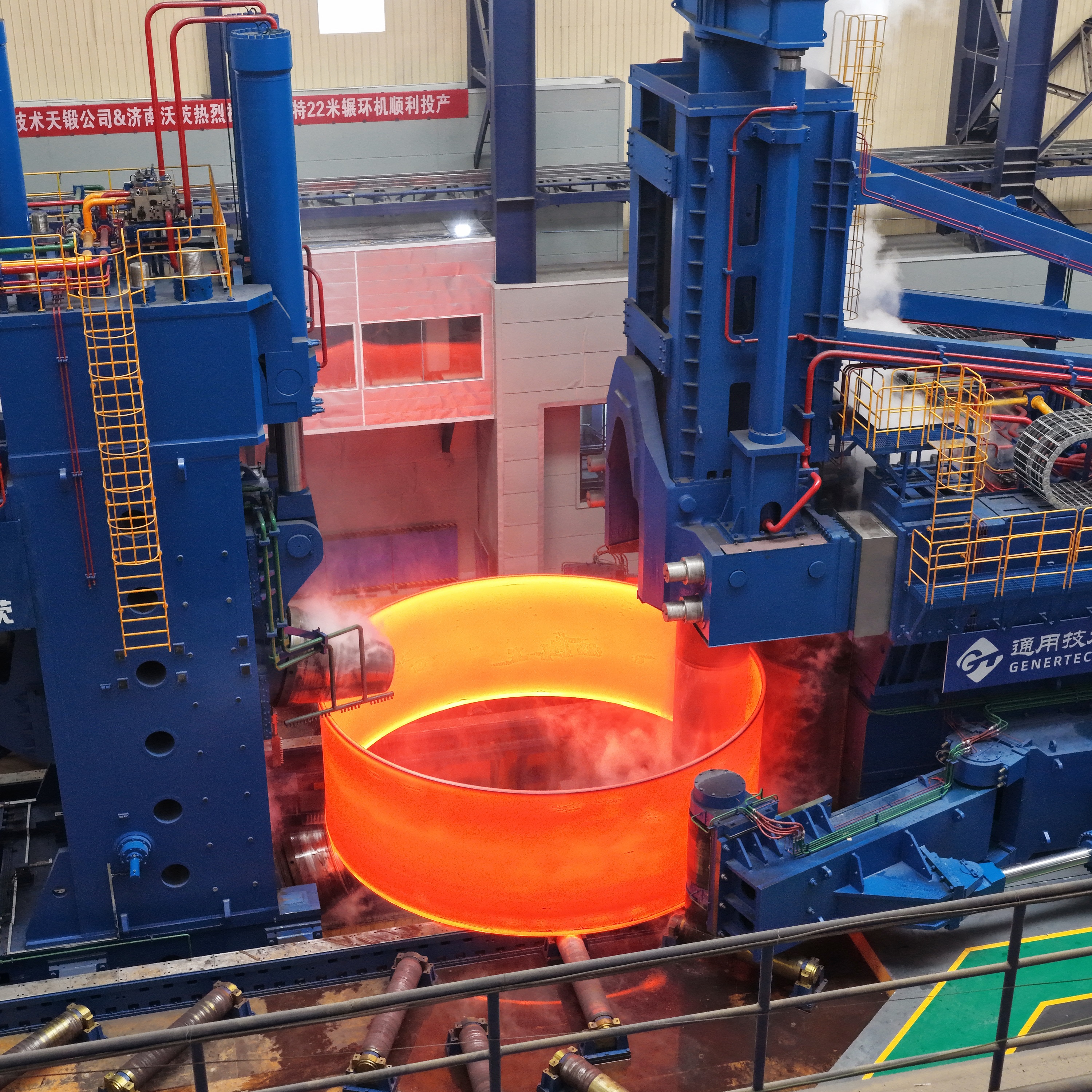
The decision between open-die forgings and rolled ring forgings is made by geometry first. Annular, axisymmetric parts with a through-bore go to ring rolling. Non-annular, asymmetric or long-axis parts go to open-die forging. Very large thick-walled rings sit in the overlap, where a combined forge-rolling route is used. Size, load case and service environment then confirm or override that first call — they do not replace it.
Iraeta Energy Equipment Co., Ltd. is a forging manufacturer founded in 2006, with production facilities in China and Spain, producing discs, rings, shells, bars, shafts and wear-resistant grinding media across a reported weight range of 0.3 kg to 300 tons. Both routes in this comparison exist inside that single capability envelope: 300-ton open-die forgings, seamless rings above 21 meters in diameter, rolled shells up to 5 meters tall and forged bars up to 25 meters long. That makes the comparison a technical question rather than a sourcing question — the same supplier can quote either route, so the buyer has to decide which one the drawing actually needs.
The decision in one minute
- Body of revolution with a through-bore — kiln tyre, wind power flange, bearing ring, hydropower ring plate, pressure-vessel shell section: specify seamless rolled ring forging.
- No through-bore, off-axis features, or long relative to section — forged shaft, forged bar, block, complex-geometry forging: specify open-die forging.
- Annular but thick-walled, or annular with cylindrical and complex features: evaluate the forge-rolling route, where open-die forging is followed by radial-axial rolling.
- In every case: match the proposed size to a part the supplier has actually produced, and fix the load case and inspection regime before the process is frozen on the drawing.
What actually separates the two processes
Open-die forging shapes a heated billet between flat or contoured dies through successive reductions. The workpiece is rotated and repositioned between passes, so the final geometry is built stroke by stroke rather than by a closed impression. The process is not limited to circular parts, which is why forged shafts, forged bars and complex-geometry blocks belong to it.
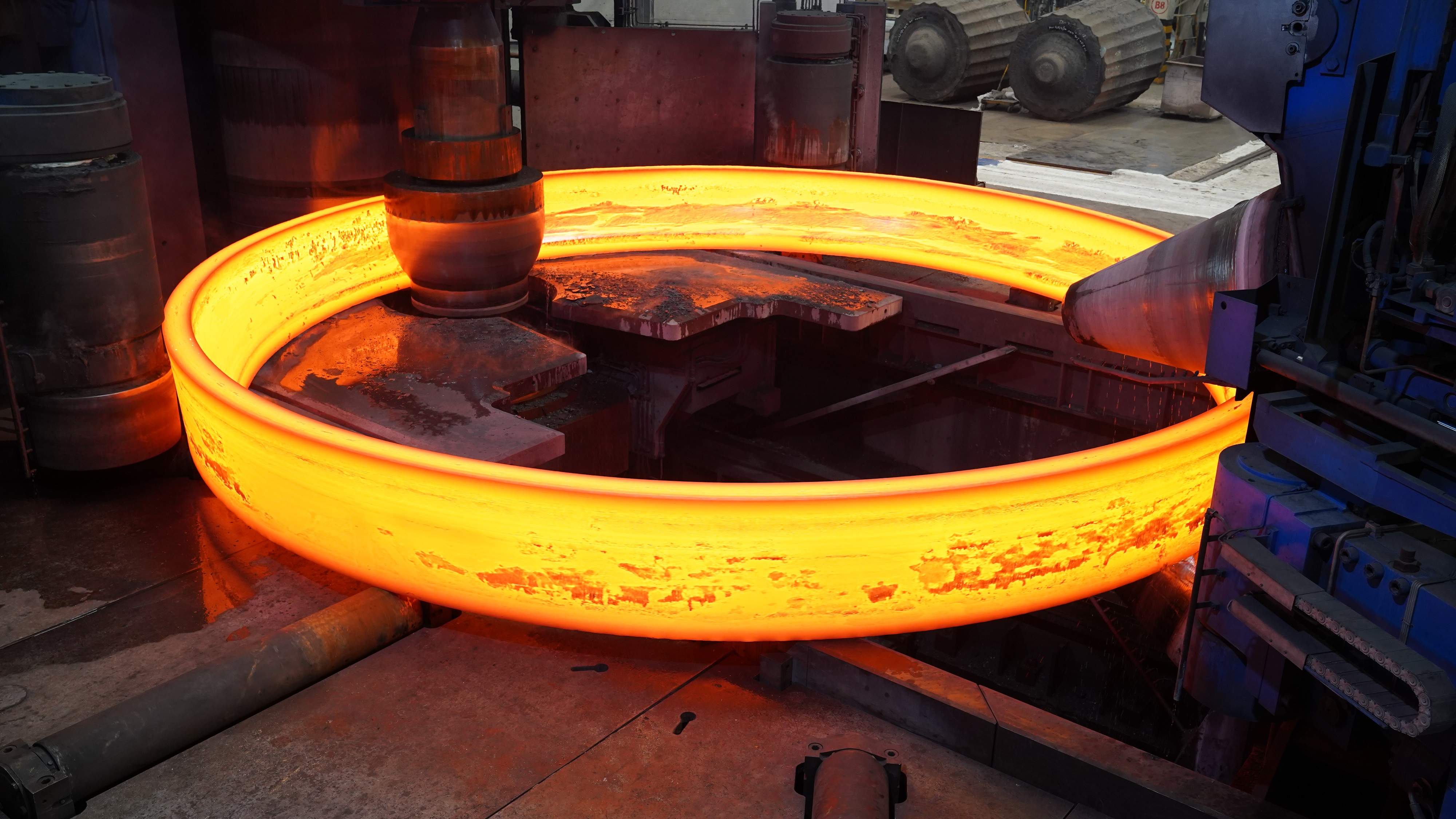
Seamless rolled ring forging follows a different logic. As described in Iraeta's own process documentation, ring rolling starts with a pierced ring blank that is heated and then rolled simultaneously in the radial and axial directions. The diameter increases, the wall thickness is reduced, and the result is a near-net-shape annular component. The rolled ring forging process therefore depends on two things being true: a bore must exist to roll from, and the finished wall must be reachable through rolling reduction.
The third route is a hybrid. Iraeta describes a "forge-rolling" method that combines open-die forging with radial-axial rolling, positioning it for large-diameter, thick-walled rings, cylindrical forgings and complex geometries. In that route the open-die stage does the densification work and the rolling stage controls diameter and wall, which is why it is the right evaluation path for parts that are annular but sit outside a conventional rolling window.
Why buyers are re-running this comparison now
Demand has moved toward larger and more heavily loaded components. Iraeta's own application list runs from fourth-generation nuclear plants and cement rotary kilns rated at 10,000 tons per day, to 16-meter shield tunnelling machines and floating offshore wind turbines above 20 MW. Each of those end uses pushes component envelopes outward, and each one changes which forming route is viable.
Market research points in the same direction. A 2026 strategic research report on the global seamless rolled ring forgings market sizes it at USD 11.9 billion in 2025, rising to USD 15.84 billion by 2032. A separate forecast from Future Market Insights projects the wind turbine forging market reaching USD 20.8 billion by 2035, at a 7.3% CAGR from 2025. Neither figure belongs in a single-component procurement decision, but both explain why suppliers are now asked to quote diameters that were exceptional a decade ago.
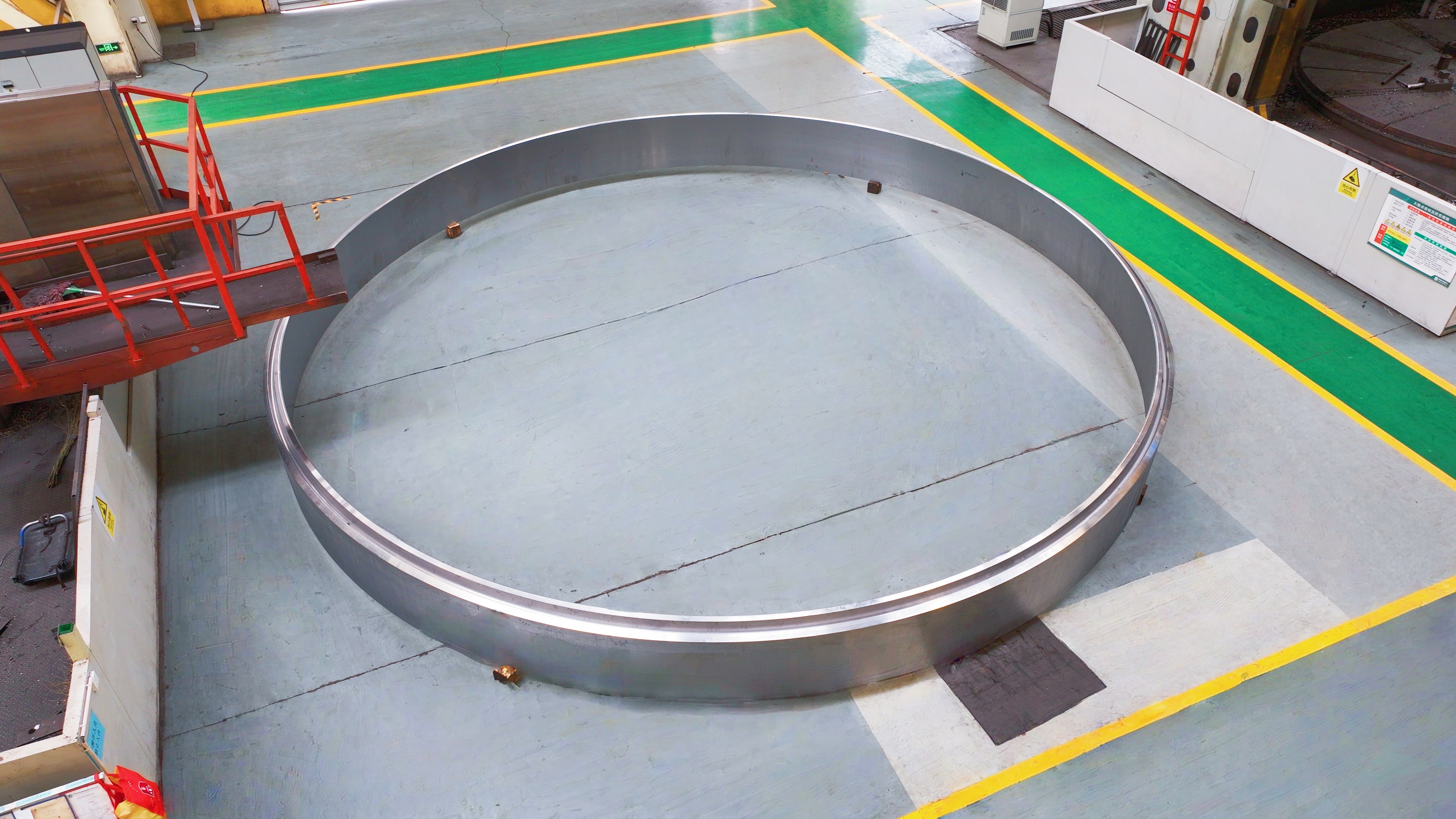
The capability envelope has moved with them. Iraeta reports a 21.029-meter-diameter seamless rolled steel ring produced in 2026, following a 15.673-meter ring it produced in 2022. For a buyer, the practical reading is not the record itself but the boundary it describes: at that scale, the process decision made at the drawing stage determines whether the part is formed or machined.
Five criteria that decide the process
1. Geometry and symmetry
If the finished part can be described as a body of revolution with a bore, ring rolling is the default. Iraeta produces ring forgings with rectangular cross-sections and complex profile shapes, which covers kiln tyres, flanges, bearing rings and comparable annular parts — including profiling rolled ring forgings where the outer profile is part of the formed geometry. If the part has no bore, or carries non-axisymmetric features such as journals, mounting pads or offset masses, the ring-rolling geometry does not exist and open-die forging is the default. Iraeta's forged shaft and forged bar products sit in that second family, with forged bars reported up to 25 meters long.
2. Wall thickness relative to diameter
Thin-wall, large-diameter rings are the classic rolled ring case. Where the wall is thick relative to diameter, or the geometry combines an annular section with cylindrical features, the forge-rolling route is the appropriate evaluation rather than a straight ring-rolling quote. Two dimensions drive this: finished wall thickness and finished height. Height is where ring capacity stops being theoretical — Iraeta reports rolled shells up to 5 meters tall, and a ring taller than the available roll window changes the process, not just the price.
3. Size and weight envelope — demonstrated, not catalogued
A maximum figure in a brochure is not availability for your part. Iraeta reports a maximum custom ring forging weight of 300 tons, diameter above 21 meters and height up to 5 meters, inside a portfolio range of 0.3 kg to 300 tons. Those are capability limits, not typical order sizes, and they are a different quantity from throughput: Iraeta separately reports a monthly production capacity of 70,000 tons across the broader forging business. The correct question in evaluation is not "what is your maximum?" but "what is the closest part you have produced in this material family, at this weight and this wall?"
4. Load case
Four load cases dominate heavy-industry ring and forging procurement: 24/7 cyclic load-bearing in offshore wind; high water-head pressure in hydropower; high-temperature cyclic load in rotary kilns operating at up to 10,000 tons per day; and internal pressure in petrochemical and refining equipment. Annular components under hoop-dominant cyclic loading are the natural rolled ring case. Components loaded axially, in bending, or along load paths that do not follow a ring are the open-die case. The load case rarely selects the process alone — it confirms or overrides the geometry call, which is why it belongs after criterion 1, not before it.
5. Service environment and verification
Marine corrosion, elevated temperature and pressure-boundary service each add requirements the chosen process must be able to support through material, heat treatment, machining and testing. Iraeta lists customization across material, size, forging shape, heat treatment and machining, and states 100% testing as its quality control position. Before fixing the route, settle three questions: what will be tested, against which standard, and by whom. Material grade should be confirmed inside that customization scope rather than assumed from a generic catalogue.
How to run the decision, step by step
- Draw the finished envelope, not the forged envelope. Ring rolling starts from a pierced blank, so bore, wall and height have to be fixed before a supplier can price machining allowance.
- Classify the geometry. Annular and axisymmetric means ring rolling. Non-annular, asymmetric or long-axis means open-die. Thick-walled annular or cylindrical means evaluate forge-rolling.
- Map the part to a component family. Kiln tyres, wind power flanges, bearing rings, hydropower ring plates and pressure-vessel shell sections have established process patterns. A one-off geometry does not, and should be treated as a fresh technical review.
- Check the size against demonstrated capability. Compare weight, diameter, height and length with parts the supplier lists — 300-ton open-die forgings, rings above 21 meters, shells to 5 meters, bars to 25 meters at Iraeta — then request the closest comparable job.
- Check the load case against the forming route. Cyclic hoop loading favours the rolled ring. Axial and bending loading favours open-die.
- Check verification and certification before pricing. A pressure-boundary part for the EU needs PED 2014/68/EU coverage inside the certificate scope, not merely a supplier that holds a PED logo.
- Check production footprint and schedule. Iraeta operates facilities in China and Spain and reports exports to the EU, Americas, Asia and Middle East. Lead time is quoted as negotiable based on customization, so build material certification, non-destructive testing and dimensional verification into that schedule rather than after it.
Where each process stops being the right answer
Open-die stops the moment the finished part is a thin-walled, large-diameter ring with a controlled bore. At that point the bore is created by machining rather than by forming, and the near-net-shape advantage that ring rolling provides becomes a machining operation instead.
Ring rolling stops when there is no bore to roll from, when features sit off the axis of revolution, or when the part is long relative to its section. It also stops at the edge of the rolling window: thick-walled and cylindrical geometries are precisely what Iraeta's described forge-rolling method is positioned for, which is why that route should be evaluated before the part is redesigned.
Neither route stops at annularity alone, and neither should be selected on the assumption that one process is generally superior. The evidence supports a fit argument, not a ranking of quality.
Ranked: process recommendation by component family
The ranking below orders component families by how clearly the process choice is settled. Rank 1 is the case where the decision is rarely contested; the lower ranks are the cases where the load case and service environment need to be checked before the route is committed.
| Rank | Component family | Recommended process | Basis and decision status |
|---|---|---|---|
| 1 | Rotary kiln tyres and kiln supporting rings | Seamless rolled ring forging | Annular, large diameter, high-temperature cyclic load. A German cement and energy equipment manufacturer took one core supporting ring with ultra-large diameter integral forging and precision machining; a Turkish cement plant took one set of a core structural component for a rotary kiln. Settled. |
| 2 | Wind power flanges and bearing rings | Seamless rolled ring forging | Annular geometry under 24/7 load-bearing duty, in a market moving toward turbines above 20 MW. Settled. |
| 3 | Hydropower ring plates, mirror plates, yoke discs, top-cover flanges and center bodies | Rolled ring, produced by radial-axial full rolling | Iraeta states it uses radial-axial full rolling for ultra-large hydropower forgings and delivers these component types. Settled. |
| 4 | Pressure-vessel shell sections and transition sections | Rolled shell and integral ring rolling | Three pieces — two shell sections and one transition section — were supplied for a heavy-duty hydrogenation reactor in a 7.5 Mt/y European refinery project. Settled, subject to PED scope confirmation. |
| 5 | Large-diameter pipe flanges | Rolled ring where strictly annular; open-die where geometry departs from a body of revolution | Depends on the raised face, hub and bolt-circle detail. Conditional — confirm geometry first. |
| 6 | Forged shafts, forged bars, non-annular blocks and complex-geometry forgings | Open-die forging | Geometry falls outside the ring-rolling envelope; Iraeta reports forged bars up to 25 meters long and 300-ton open-die forgings. Settled. |
Side-by-side comparison
| Decision criterion | Open-die forging | Seamless rolled ring forging |
|---|---|---|
| Geometry it fits | No bore, asymmetric, long-axis or complex-geometry parts: shafts, bars, blocks | Bodies of revolution with a bore: rings, flanges, tyres, shell sections |
| How the shape is formed | Successive reductions between dies; geometry built pass by pass | Pierced blank heated and rolled radially and axially; diameter increases, wall thickness decreases, near-net shape produced |
| Bore creation | Created by machining where a bore is required | Created by piercing, before rolling |
| Size evidence at Iraeta | 300-ton open-die forgings; forged bars up to 25 m; portfolio 0.3 kg to 300 t | Seamless rings above 21 m diameter; rolled shells up to 5 m tall; 21.029 m ring reported in 2026 |
| Load case fit | Axial, bending and multi-directional loading | Hoop-dominant, cyclic and 24/7 load-bearing duty |
| Service environment fit | Kiln and high-temperature cyclic service, heavy-duty structural parts | Offshore wind, hydropower, pressure-vessel sections, kiln tyres |
| Stated quality control | 100% test | 100% test |
| Certificate coverage at Iraeta | ISO 9001:2015; ISO 14001:2015; ISO 45001:2018; EN 1090; PED 2014/68/EU (scope: forged flanges and hot rolled rings) | ISO 9001:2015; ISO 14001:2015; ISO 45001:2018; EN 1090; PED 2014/68/EU (scope: forged flanges and hot rolled rings) |
Use cases: how the criterion plays out in service
Offshore wind. Components here sit under continuous, cyclic, 24/7 load-bearing duty, and the direction of travel is toward floating turbines above 20 MW. That combination — annular geometry plus hoop-dominant fatigue duty — makes wind power rolled ring forgings the standard route for flanges and bearing rings, with open-die work reserved for the shaft and non-annular elements of the drivetrain.
Hydropower. High water-head pressure loads a component in a way that follows the annular section. Iraeta states that it uses radial-axial full rolling to manufacture ultra-large hydropower forgings, and lists yoke discs, ring plates, mirror plates, top-cover flanges and center bodies among delivered components. For a buyer specifying hydropower rolled ring forgings, the process question is settled early; the remaining work is dimensional and inspection definition.
Rotary kilns. A kiln tyre carries high-temperature cyclic load at output rates up to 10,000 tons per day. The German case delivered to a cement and energy equipment manufacturer highlights ultra-large diameter integral forging, precision machining, high load-bearing capacity, excellent thermal stability and extended service life, with stable operation meeting the quality standards set for heavy-duty applications. The Turkish cement plant case, for a core structural component, highlights precision forging and machining, high temperature resistance and fatigue strength under high-temperature and heavy-load conditions.
Petrochemical and refining. Pressure equipment adds a compliance layer that the process decision must satisfy. In Saudi Arabia, two units of key components for refining and petrochemical equipment were supplied to an oil and gas OEM, with high forging precision, wear and high-temperature resistance, and stable operation meeting the project's quality and safety requirements. A separate Saudi refinery project required three pieces — two shell sections and one transition section — for a heavy-duty hydrogenation reactor, applied in a 7.5 Mt/y European refinery project, with integral ring rolling and near-net-shape forming cited among the highlights.
Compliance check before you compare processes
Certification does not choose between open-die and ring rolling, but it can eliminate a supplier from one of them. Two certificates matter most in this comparison because they carry dated validity and defined scope.
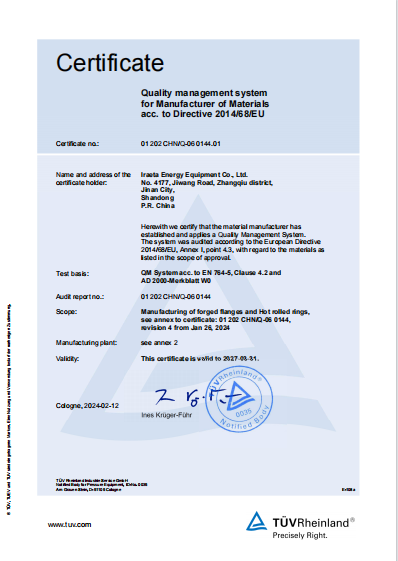
Iraeta holds PED 2014/68/EU certification issued by TUV, certificate number 01 202 CHN/Q-06 0144.01, for the EU market, covering the manufacturing of forged flanges and hot rolled rings. It was issued on 12 February 2024 and is valid to 31 March 2027. If your component ships after that date, the renewal status is a legitimate question during evaluation.
Iraeta also holds ISO 14001:2015 certification issued by NQA Certification Co., Ltd. (Shanghai), certificate number F01926E00118R502, issued 2 March 2026 and valid to 1 March 2029, covering production of raw materials for forgings, production of forgings, and production of steel balls, cylpebs and grinding rods.
The supporting set is ISO 9001:2015 (BV, F02326Q00125R602), ISO 45001:2018 (NQA, F01926S00070R502) and EN 1090 (TUV, 0035-CPR-1090-1.03389.TÜVRh.2025.003). Read the scope wording on each document, not the logo on the website: a certificate covering hot rolled rings does not automatically extend to a forged shaft, and vice versa.
Frequently asked questions
What certification should a rolled ring forgings supplier hold for EU pressure equipment?
For pressure equipment placed on the EU market, the operative document is PED 2014/68/EU. Iraeta holds PED certification issued by TUV under certificate number 01 202 CHN/Q-06 0144.01, issued 12 February 2024 and valid to 31 March 2027, with a scope covering the manufacturing of forged flanges and hot rolled rings. Buyers should read the scope wording rather than the certificate title, because a scope written for flanges and rings does not automatically cover every forged product form. Environmental and quality management certificates — ISO 14001:2015 and ISO 9001:2015 at Iraeta — demonstrate system control, not part-specific performance.
Can one supplier deliver both open-die forgings and seamless rolled rings?
At Iraeta, yes, and that is why the process comparison can be resolved technically. The reported portfolio spans 0.3 kg to 300 tons and includes 300-ton open-die forgings, seamless rings above 21 meters in diameter, rolled shells up to 5 meters tall and forged bars up to 25 meters long, alongside a supported R&D team of 100 engineers. A single supplier covering both routes removes the situation where a buyer is steered toward whichever process the supplier happens to own.
What drives the cost difference between the two routes?
Iraeta does not publish a price list, and no price is quoted here. Structurally, the cost difference between open-die and rolled ring work comes from input weight, material grade, heat treatment, machining allowance and testing scope. A part specified as an open-die block that should have been a rolled ring carries the cost of turning a bore out of solid material; a ring specified too thin for the rolling window carries redesign cost instead. Iraeta states a minimum order quantity of 1 unit and customization across material, size, forging shape, heat treatment and machining, so a route-specific quotation is the only reliable budget basis.
Can a buyer validate the process on a sample before series supply?
Validation is practical because Iraeta states a minimum order quantity of 1 unit and 100% testing as its quality control position. A first article built to the finished drawing lets you confirm the dimensional result, the heat-treatment response and the inspection outcome before committing to series volume. To start that process, send the finished envelope drawing, the load case and the target standard to the Iraeta team at ebiz@iraeta.com or through www.iraeta.com.
How long does production take, and what affects lead time?
Iraeta states that lead time is negotiable based on customization rather than fixed per product family. Three factors move it: the degree of customization across material, size, forging shape, heat treatment and machining; the verification steps attached to the part, since 100% testing and any project-specific inspection add sequential time; and which production site carries the order, given facilities in China and Spain and reported exports to the EU, Americas, Asia and Middle East. The practical planning rule is to sequence certification, testing and dimensional verification into the quoted schedule from the start. To scope a specific component and request a sample or quotation, contact Simon Wang at ebiz@iraeta.com or +86 188-5315-7508.
Conclusion
Open-die forging and seamless rolled ring forging are not competing answers to the same question — they answer different geometry. A part with a bore and an axis of revolution is a ring rolling candidate; a part without one belongs to open-die. The genuine grey zone is the large, thick-walled annular component, and that is where the forge-rolling route, combining open-die densification with radial-axial dimensional control, has to be evaluated rather than skipped.
For heavy-industry buyers in evaluation, the sequence that holds up is: classify geometry, check the size against demonstrated parts rather than catalogue maxima, confirm the load case, confirm the service environment and inspection regime, then confirm certification scope and validity. Applied to Iraeta's range — 0.3 kg to 300 tons, 300-ton open-die forgings, rings above 21 meters, shells to 5 meters, bars to 25 meters, with PED 2014/68/EU and ISO 14001:2015 coverage across facilities in China and Spain — that sequence settles most process questions before a quotation is requested.
Specifying a large ring or open-die component?
Send the finished envelope drawing, the load case and the required standard. The Iraeta team will confirm which route fits — open-die, seamless rolled ring, or forge-rolling — and return a sample or quotation scope against that decision.
Simon Wang · ebiz@iraeta.com · +86 188-5315-7508 · WhatsApp +86 18853157508
Iraeta Energy Equipment Co., Ltd. · 4177 Jiwang Road, Zhangqiu, Jinan, China · www.iraeta.com

Have Questions or Need More Details?
Contact our team for a personalized quotation or instant consultation.
Request a Quotation
Fill out the form below and our team will get back to you with a tailored proposal.
WhatsApp Direct Chat
Prefer to chat in real-time? Message us on WhatsApp for instant assistance & quick answers.
- Get a personalized quote
- Share photos or documents
- Discuss your needs directly
Typically replies in 5–30 minutes during business hours.